

By Sarath Dissanayake –

Sarath Dissanayake
Shattering Barriers: The Triumph of Intellectual Equity
In the modern history of Sri Lanka, few legacies have left as indelible an imprint on the collective destiny of its people as the unique free education system. Envisioned and introduced by the late Minister of Education, C.W.W. Kannangara, this revolutionary policy was designed to democratize knowledge, ensuring that poverty would never be a barrier to human potential. Decades later, at a time when the national psyche is yearning for inspiration, three remarkable products of this very system have done their motherland immensely proud. Emerging from humble backgrounds, these individuals have shattered barriers, captured the attention of mainstream and social media, and emerged as true national icons and role models.
The entire nation stands united in applause for these three heroes. They have done their motherland justice, proving to every struggling child in every remote corner of the island that the impossible can be made possible. They are no longer just successful individuals; they are national treasures and the ultimate blueprints for future generations. These three outstanding characters deserve recognition, appreciation, praise, and to be treated as national treasures at the highest level.
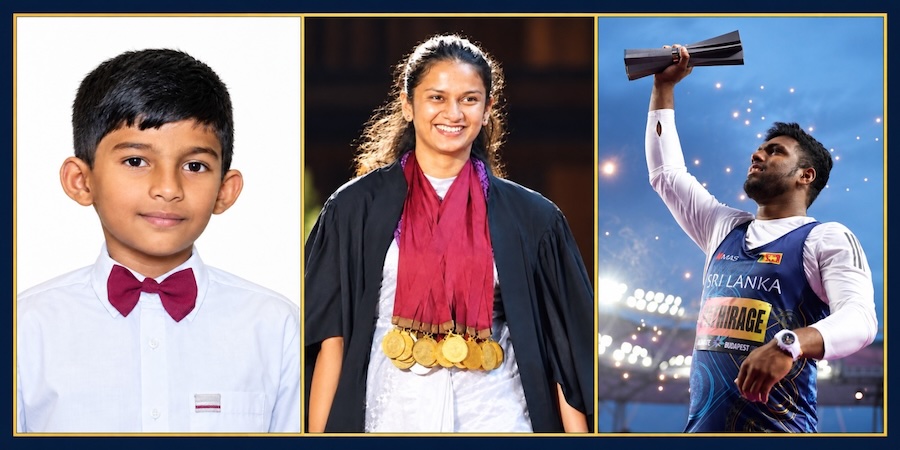
Profiles of Excellence Matrix
|
Profile |
Origin / Location |
Field of Achievement |
Key Milestone |
|
Grade 5 Prodigy |
Ahatuwewa Model Primary, Kurunegala |
Primary Education |
Island-wide Top Scorer (Scholarship Exam) |
|
Dr. Hasini Rangika Epa Arachchi |
Faculty of Medicine, Colombo |
Advanced Medicine |
Swept historic gold medals at General Convocation |
|
Rumesh Tharanga Pathirage |
Kalutara, Western Province |
International Athletics |
World Title Champion (91.09m Javelin Throw) |
Life-long Predicaments, Indomitable Spirit, and Remarkable Courage
Their stories are not tales of privilege or wealth offered on a silver platter. Instead, they are deeply moving chronicles of grit, courage, and an unwavering determination to transform familial predicaments into stepping stones for lifetime accomplishments. They have learnt the hard way, possessing the intrinsic wisdom to take a cue from their familial hardships and bring to bear what other students from the country too could achieve when fueled by sheer resilience. The brilliant medical graduate from Ambalangoda, the top-scoring primary student, and our world-class champion thrower from Kalutara are living testaments to the fact that when the state guarantees intellectual equity, the human spirit will inevitably rise to conquer the global stage.
Each of these achievements represents a victory over steep systemic odds. The Grade 5 scholarship exam has long been a highly competitive gateway for rural students seeking better educational opportunities, and securing the island-wide top spot by Danoj Theekshana Weerasekara from the Kurunegala District underscores the power of foundational dedication. In higher education, Dr. Hasini Rangika Epa Arachchi’s historic sweep of 16 gold medals at the University of Colombo General Convocation (MBBS-Final Exam) 2026, stands as an unprecedented feat of academic excellence, proving that local institutional training can produce minds of global caliber. Meanwhile, on the global sports stage, Rumesh Tharanga Pathirage’s massive 91.09-meter javelin throw brought international glory to Kalutara and the entire country, proving that Sri Lankan athletes can dominate at the highest tier of world athletics.
Scholarship Prodigy: Danoj Theekshana’s Top-Scoring Feat
The first of these heartwarming stories takes us to a quiet village school in Kurunegala , where Danoj Theekshana Weerasekara has done the unthinkable by top-scoring island-wide in the highly competitive Grade 5 Scholarship Examination.
This young boy’s journey is defined by a life full of agony and extreme hardships. At a tender age, he lost his mother—his best companion in life. Left with the profound void of maternal care, his childhood could have easily been consumed by grief. However, his father courageously took up the cudgels of grooming him, single-handedly bearing the immense burden of his upbringing and education. To make matters worse, his life had its own ups and downs; his dwelling is located in the dense jungle roamed by elephants. The boy has frequently come face to face with wild elephants and his sheer and timely luck has saved his life from elephant attacks on numerous occasions. Given the dangers lurking behind the forest cover, the boy and family have been spending their lives in eternal fear of elephant encounters, and that much has been the predicament and agony with which he has destined all throughout—in constant danger at home, at school, and in between, which is a life full of uncertainties and fear psychosis.
Living in an environment stripped of affluent luxuries and shadowed by environmental perils, Theekshana Weerasekara from Ahatuwewa Model Primary School chose to view life’s severe trials not as an excuse for failure, but as a challenge to be overcome. Guided by his father’s sacrifices and his own inner wisdom, he studied diligently within the walls of his modest village school. When the results of the island-wide examination were announced, his name sat at the absolute apex of the list. By outperforming thousands of students across the nation, this village prodigy did his Alma mater and his community proud, proving that genius knows no geographic or financial boundaries. (Link for Theekshana’s video is at https://www.facebook.com/reel/1386503319703594)
Academic Icon: Dr. Epa Arachchi’s Medical Feat
Meanwhile, in the coastal town of Ambalangoda, another extraordinary narrative of excellence was being written. A young female medical student, relying entirely on her own merit and the robust foundations of free education, reached the pinnacle of academic success at the MBBS Final Exam 2026 and bagged 16 out of 32 Gold Medals.
Medical school is universally recognized as a grueling test of endurance, but this young woman transformed it into a historic milestone. Dr. Hasini Rangika Epa Arachchi graduated from the Faculty of Medicine, with flying colours, winning 16 gold medals at the general convocation. Her stellar performance and winning streak is so rare – it instantly swept across the country like wildfire, marking an unprecedented, record-breaking feat for a single graduate in Sri Lankan medical school history.
Almost overnight, she became the ultimate icon and the talk of the town and academic circles. Her achievement is a resounding validation of the Kannangara philosophy: that a child from a regional township like Ambalangoda can stand toe-to-toe with the global elite when given equal access to education. Celebrated across social media networks, she stands today as a beacon of academic perfection, inspiring thousands of young women across Sri Lanka to pursue the highest tiers of scientific and medical research.
Javelin Champion: Rumesh Tharanga’s Historic Throw
The academic triumphs of these two outstanding students find a perfect, harmonious parallel in the sports world through a phenomenal Sri Lankan javelin thrower. His recent winning streak at international athletic competitions has injected an electric wave of pride into the nation’s veins.
To the distinct singular honour and pride of all Sri Lankans, Rumesh Tharanga Pathirage, a young athlete from the local town of Kalutara, on the outskirts of the Western Province, won the men’s javelin title at the inaugural World Athletics Ultimate Championship in Budapest, Hungary. He captured the global crown with a powerful, historic throw of 91.09 meters, defeating reigning Olympic champion Arshad Nadeem and other world-class competitors. Leading to his historic win, he also claimed a high-profile series of winning streaks across key international athletic competitions. His next aim is to win the Olympic Gold in 2028, an accolade he is supremely confident of achieving as the undisputed number one javelin thrower in the world.
His victory on the global stage, surrounded by the world’s most heavily funded sports programs, serves as a powerful reminder of what raw Sri Lankan talent can achieve when fueled by passion, relentless hard work, and the foundational support of a country that believes in its youth.
The Enduring Relevance of Kannangara’s Legacy
From an analytical perspective, these modern triumphs are not isolated incidents of luck; they are the direct dividends of a visionary social contract established nearly a century ago. C.W.W. Kannangara’s legacy and his wisdom in establishing the tenets of free education have produced a countless number of professionals and prodigies since 1948 across nearly every professional field. For this foundational foresight, he deserves to be permanently remembered as a national hero in the hearts of the public.
Kannangara understood that a nation’s greatest natural resource is the collective intellect of its youth, regardless of their socioeconomic origins. By institutionalizing state-sponsored education, he democratized the upward mobility of the rural masses. Today, as the country navigates complex modern socio-economic crises, preserving this structural equalizer remains paramount.
Doldrums in Education and Healthcare Services
Regrettably, the recent palpable concerns gripping the nation are no longer born of mere hearsay, but of considerable public outcry following recent developments involving public remarks made by government representatives. A case in point involves the remarks attributed to NPP representatives on upcoming education and healthcare sector reforms, which have triggered intense public anxiety over the perceived cuts and curtailment of essential services. In a narrative that many view as an insinuation of impending austerity, statements have surfaced hinting at restrictions on routine walk-in visits to government hospitals to manage overcrowding and constraints associated with rampant shortages of drugs and medical resources. Instead, patients may be obliged to pass through a primary healthcare physician first, alongside suggestions of an increased reliance on traditional home remedies like Kotta-malli (Coriander) for routine illnesses—a remedy that, unfortunately, is no panacea for deep-seated systemic ills.
To make matters worse, the status quo of the education sector has come under intense speculation regarding potential plans to shut down certain schools in remote areas with low student enrollment, labeling them a drain on the country’s scarce resources. These remarks have drawn sharp ire from opposition quarters and sent shockwaves across the country leading to speculations and rumours among the general public at large.
Fate of Sports Bodies and International Fixtures at Stake
It is equally baffling to note that the status quo of certain national sports bodies has fallen out of sync, taking a turn for the worse. Following the resignation of the highly criticized Sri Lanka Cricket (SLC) board amidst allegations of poor administration, the newly established Cricket interim Transformation Committee has come under intense pressure due to mounting public scrutiny. On the back of these tumultuous developments, the International Cricket Council (ICC) recently stripped Sri Lanka of its statutory rights to host the inaugural ICC Women’s Champions Trophy in February 2027.
This sudden venue shift deals a heavy blow to the local sporting entities. The fallout not only denies the nation the prestige of hosting a premier global fixture, but it also compromises an invaluable window to market Sri Lanka to thousands of visiting international cricket fans. Consequently, this serves as a massive missed opportunity for Sri Lanka’s travel and tourism sectors, depriving local hospitality stakeholders of an economic lifeline for their well being and family support.
The opposition camp has capitalized on these rhetorical missteps, accusing the NPP of a major betrayal of the electorate barely two years into office. By casting a shadow over the future of education, healthcare, and sports, the government’s current trajectory stands in stark contrast to its pre-election pledges of unprecedented public benefits and institutional growth. This shift ultimately threatens the foundational systems intended to guide Sri Lanka’s next generation into a stable, 21st-century era of prosperity.
Step-Motherly Treatment of Free Education and Healthcare is Politically Suicidal
Shifting our focus to current governance, at a time when the current NPP government has completed its second year in office, it is imperative to judge the progress of its policies and evaluate how far the administration has succeeded in implementing its policy manifesto in toto. When we juxtapose the overall performance of the NPP’s conduct in governance against the benchmarks and Key Performance Indicators (KPIs) set out in their manifesto, the resulting scorecard reveals notable gaps in policy alignment and execution.
As ardent critics, beneficiaries, and proud products of free education and healthcare, the Sri Lankans genuinely expect the government to safeguard these systems—which have historically placed Sri Lanka at the apex of UN human development indexes and secured its status as the best-performing country in South Asia. It is the sacred duty of the powers that be to deliver a true system change that harnesses these seven decade-old pillars. The vast majority of people who overwhelmingly voted the NPP into power did so with the expectation that these primary sectors would remain uncompromised, even as the nation navigates a period of uncertainty. For rural families, the future of their sons and daughters is their true bread and butter; consequently, any step-motherly treatment of these sectors by the state is politically suicidal.
NPP Must Deliver on Pledges to Rejuvenate Education, Health, and Sports
As I pointed out in my one of my earlier pieces on education reforms in February 2026. The NPP government can no longer rely on bureaucratic excuses or blame systemic bottlenecks to justify delays in delivering its promised reforms across the education, healthcare, and sports sectors. Instead, it must demonstrate the political will to invest handsomely in these pivotal sectors, diverting robust budgetary allocations as already pledged—such as the targeted 6% of GDP for education and a substantial expansion for health—commensurate with clear national priorities. The administration cannot hide behind paper-thin excuses to stall pragmatic policies, system change initiatives, and election manifesto pledges at the expense of the younger generation’s right to excel.
Towards this end, Prime Minister, Dr Amarasuriya, being an accomplished academic expert and seasoned educationist, is uniquely positioned to spearhead these changes. She understands the strategic frameworks required to reinvent the education sector for youth – seeking viable career prospects. Ultimately, the government must act decisively to expand horizons in higher education, vocational training, and technical fields against global benchmarks for overall societal progress.
Furthermore, these investments must extend equally to sports and healthcare infrastructure to match long-term national growth projections. No contemporary fiscal constraint can diminish the state’s obligation to protect and promote free education and health. These pillars have formed the cornerstone of Sri Lanka’s societal advancement since independence in 1948, proving their resilience across successive regimes.
Key Takeaways: A Blueprint for the 21st Century
A Nation’s Pride: Ultimately, “How Three Village Prodigies Reignited the Spirit of Sri Lanka” serves as a powerful testament to the transformative power of resilience, unity, and grassroots determination. Their journey proves that extraordinary change does not always begin in corridors of power, but often in the hearts of ordinary individuals from humble beginnings. By rising above adversity, these village youth did more than achieve personal success—they restored a sense of national pride and offered a fractured nation a renewed blueprint for collective hope.
To fully realize this vision and secure long-term future prospects, profound system change must be enacted. Future efforts should be aimed at rejuvenating education, health, and sports; with strategic interests at heart; with the 21st century in mind; with the people at the focus; and with the Sri Lankan nation at its core. By moving away from short-term fixes, Sri Lanka can establish modern, forward-thinking institutional frameworks that align with global 21st-century demands while keeping the well-being of ordinary citizens at the center of development.
Nurturing equitable education pathways, robust public health initiatives, and a revitalized rural sports infrastructure today ensures a sustainable framework. This people-centric system change guarantees that progress is not temporary, but rather a permanent restructuring that turns momentary hope into a lasting legacy of national prosperity. Their legacy stands as a timeless reminder that the true spirit of Sri Lanka lies in its people’s unyielding capacity to persevere and inspire.
“We found education dear and left it cheap; we found it the patrimony of the rich and left it the inheritance of the poor.” — Dr. C.W.W. Kannangara, State Council of Ceylon, 1944
*The writer is a retired Ambassador and Foreign Ministry Spokesman. He can be reached at schandrad@hotmail.com
References:
- https://www.colombotelegraph.com/index.php/education-reforms-a-must-be-embraced-by-all/– “Education Reforms: A Must and Be Embraced By All”
- https://www.colombotelegraph.com/index.php/fast-paced-online-education-in-sri-lanka-a-boon-or-bane/- ”Fast-Paced Online Education In SL: A Boon Or Bane”
chiv / September 19, 2026
Congratulations to all three on their amazing achievements.
Lot of hard work, determination and courage needed to overcome all odds.
/
raja H / September 20, 2026
Dear Mr Chiv,
I am left wondering what this article is about, really?
Yes, all these high achievers need congratulations, and I am not against such.. But such an outburst about a child who is still in grade 6, a medical student who won a lot of medals, and an athlete? Have they actually achieved anything yet really? Can you not find Sri Lankans who have actually done something apart from passing exams.
You say they succeeded because of free education.
Can I suggest 3 persons who have made it without help from the government, in fact after being attacked by the government of Sri Lanka.
1.Sivendran, the founder of Morley Fried Chicken in London, with 79 outlets, who arrived in 1985 as a refugee.
https://en.wikipedia.org/wiki/Morley%27s
2.Another refugee food supplier in New York https://www.facebook.com/share/v/1KBocsvKCh/
Thirukumar the Dosa Man.
3. Maitreya Ramakrishnan, the famous Canadian Tamil actress.
What do you think?
/
Sarath / September 20, 2026
Raja,
Thank you for your comment. However, your response makes it evident that you merely scratched the surface of the article and failed to read it in its entirety to understand its true thesis.
This piece was never just a celebratory profile of three individual high achievers. Had you read past the introductions, you would have seen that their extraordinary grit serves as a contextual baseline to address a much larger, urgent message directed at the powers that be. The core of the article is a strict evaluation of the current NPP administration’s policy alignments, Key Performance Indicators (KPIs), and the severe public outcry surrounding rumored austerity cuts—specifically potential school closures and healthcare restrictions (such as forcing reliance on remedies like Kotta-malli over systemic medical care).
Regarding the three individuals you mentioned: they are indeed remarkable examples of the resilient global Sri Lankan diaspora. However, using them to diminish the triumphs of a rural primary student, a record-breaking medical graduate, and a world-class athlete is a false equivalency. The achievements of these three local youths are direct validations of what state-guaranteed intellectual equity and free education can produce within Sri Lanka, despite steep systemic odds.
(TBC)
/
nimal fernando / September 22, 2026
Talk about one-eyed Diplomat-ting!
–
The race/ethnic card needs to be played here.
–
These are all Sinhalese ……. where are the achievements of ……. the Tamils, Muslims, Malays, Burghers, ……… other constituents of the nation?
–
Well selected, intelligent and trained diplomats promote the entire ethnic/racial mix of the nation: not just a subset.
–
No wonder, the ones who get step-motherly treatment are up in arms!
–
Lankan diplomats promote peace in the world and cause wars at home!
–
Only in Lanka: where else?
–
Oh Boy!
–
Feel like a game of Cricket? :)))
/
Nathan / September 22, 2026
nimal, What amuses me is the readiness of our commenters to engage with this all-knowing Sarath.
/
Sarath / September 22, 2026
Nathan,
Thanks.
I am glad my article could provide you with some amusement! However, when commenters rely on preposterous claims and complete fabrications, someone has to step up and introduce basic socioeconomic facts into the discussion—if only to save the forum from total fiction.
Enjoy the show.
/
Nathan / September 22, 2026
How hilarious! It is NOT your article that provides amusement! Where on did you get that idea from?
/
old codger / September 22, 2026
Nathan,
Is it animal magnetism ? He manages to get lots of comments, though most are his own.
/
Sarath / September 22, 2026
OC, Nathan
I assure you I am not chasing comment counts, nor do I claim to possess any mysterious “animal magnetism” that compels people to engage. My only habit has been to respect the platform by individually replying to each reader whenever I find a valid reason to clarify a point.
It is clear that this thorough commenting style of mine is a practice that I should stop—just as others do—as it only leads to the very predicament of being misconstrued as playing a numbers game. If you and others genuinely perceive this courtesy as an artificial inflation of the thread, then rest assured, this is the last time I will be doing so. Enjoy the forum.
Thanks for your attention n understanding.
/
Nathan / September 23, 2026
Currently 30 of the 54 comments are from Sarath.
/
Sarath / September 22, 2026
Dear OC, Nathan
Further to my previous comment on the numbers game you attributed to me regarding this thread, which reads: “Is it animal magnetism? He manages to get lots of comments, though most are his own.”
Having perused my earlier article on the UNHRC, I accidentally found yet another comment attributing to the “numbers mantra.” I quote it below for your ready reference. Initially, I cared less about this in the presumption that it was purely accidental. However, it looks to me now that this is simply not accidental, but intentional and part of a pattern:
“Out of 130 comments, more than half, the guy going around in circles, trying to defend the indefensible. LOL”
Given that, it looks to me that the “sheer numbers comment” is something certain CT readers seem to keep mimicking and repeating for whatever it is worth. I can imagine that I am in this predicament because of my penchant for commenting on CT threads, unlike other authors—a choice I now deeply regret myself.
This once again reinforces my conviction that I should stop commenting and sharing my side of the story henceforth, once and for all.
Thanks for your attention.
/
nimal fernando / September 23, 2026
Lanka gets Correspondence-Schools to train their diplomats.
–
It’ voluminous/verbose writing ……. to and fro ……. more the better.
–
Logorrhea, Prolixity, Pleonasm, Circumlocution.
–
Just imagine ……. AI utilized Correspondence-Schools.
–
Hope AKD put a stop to it ……. and get Diplomats to be more stoic …… and direct energy …….. more towards thinking.
/
Sarath / September 23, 2026
Thank you for your “vocabulary lesson” and your typical harangue on my writing style. While you may perceive objective, comprehensive analysis as “prolixity” or “circumlocution,” a seasoned approach to matters of national interest requires a full examination of the facts rather than oversimplified rhetoric.
Let me be absolutely clear: my arguments rely entirely on genuine critical reflection, not ‘correspondence schools’ or artificial intelligence, as you seem to perceive.
True intellectual engagement demands the stamina to look past the length of a text and focus on its substance.
Trust the above clarifies.
/
LankaScot / September 23, 2026
Hello Nimal,
You forgot Obfuscation, Confabulation, Grandiloquence and plain old Pedantry. It is like trying to make sense of Alan Sokal’s Paper “Transgressing the Boundaries: Toward a Transformative Hermeneutics of Quantum Gravity” where he takes the mickey out of Post Modernism. The defenders of Post Modernism tried to deconstruct his Paper – https://www.youtube.com/watch?v=SfSrIsq2cQ8
Best regards
/
nimal fernando / September 23, 2026
OC,
–
It’s all your fault! ……… vis-à-vis got the whole shindig rolling!!
–
What the blooming hell is vis-à-vis?
–
Never heard of the bloody thing ……. let alone used it: I’ve managed pretty well without any of that.
–
It’s all SM’s fault …….. rote-teaching this crap to students ……. who don’t understand ……. let alone have a clue where or how to use it.
–
–
Thank God it’s not Scottish! Or is it?
–
No wonder, the Scots have achieved so much independently of the English!
–
Imagine what more they would’ve accomplished ………. if they are not tethered to the English?
–
–
Did someone say the Tamils? ……. And Sinhalese-Buddhists like Sarath unable and unwilling to let them go.
–
Tamils are the security-blanket ……. the insecure Sinhalese-Buddhists garb-on to so tightly.
–
–
Without the Tamils nothing to grab on to …….. except one another.
–
LM grabbing Ranil, Ranil grabbing Native, OC grabbing Ranil and Ramona, ……….
–
Everyone trying to get away from Sarath …… I’ll be faster than frigging Usain Bolt!
–
Everyone breaking records ……. records a plenty for Lanka!
/
Sarath / September 22, 2026
Nimal,
Thank you for your candid feedback. I want to clear the air immediately and assure you that it was never my intention to single out the majority community or promote one ethnicity over the diverse and valued Tamils, Muslims, Malays, and Burghers of our nation.
When I compiled the article, the focus was entirely on real-time relevance. Three incredible achievements had just gripped the national spotlight: Danoj Theekshana’s inspiring triumph in the Year 5 scholarship exam despite harsh familial struggles, an MBBS student winning a record-breaking 16 gold medals, and Rumesh Tharanga’s historic javelin throw. Because these events coincided naturally with public debates sparked by the Kalutara rally regarding education and healthcare changes, they became the anchor of my piece.
That these three individuals are Sinhalese was entirely coincidental. However, I completely understand how this exclusive focus appeared to readers, and I recognize that it caused frustration.
If this pure coincidence has offended anyone or caused a pain of mind, I offer my humble and sincere apologies from the bottom of my heart.
(TBC)
/
Sarath / September 22, 2026
Nimal ( Continued from previous comment)
It was genuinely written without a prejudiced mind. I celebrate the success of all Sri Lankans equally, and I appreciate your reminder of the vital importance of promoting our entire national mix as we work toward a peaceful country where everyone belongs.
Thanks for your kind attention and understanding.
/
Sarath / September 22, 2026
Nimal (Dear CT Readers),
1) I wish to put a definitive end to the baseless assertions regarding the narrative intent of my article.
2) In the article titled “A Nation’s Pride: How Three Village Prodigies Reignited The Spirit Of Sri Lanka” in its entirety, I have never once used the word “Sinhalese”. I intentionally and strictly refrained from defining these three individuals by their ethnicity or religious identity. To do otherwise would be entirely prejudicial to the multi-ethnic, multi-religious, and multi-racial character of Sri Lanka.
3) Despite this stark reality and plain truth, certain readers have weaponized ethnic, religious, and political cards to cast completely uncalled-for aspersions against me, the article, and three village prodigies who have been rightfully celebrated by all Sri Lankans across the board for their historic feats of excellence. It is disappointing to note, these comments are driven purely by narrow-minded, petty communal mindsets that have no place in a civilized world.
(TBC)
/
Sarath / September 22, 2026
Nimal Continued from previous comment)
4) What is particularly baffling is how certain CT readers rush to attach ethnic communal labels to these achievers based solely on their names. Mind you, to any foreigner, these individuals are seen simply and cleanly as Sri Lankans—not as X, Y, or Z (based on their ethnic, religious or racial identities) Outside observers do not possess the regressive local habit of immediately sorting names into rigid communal boxes.
5) If the outside world can view our national icons simply as Sri Lankans, it is high time we shun this narrow mindset ourselves and stop painting our youth through the prism of faith, ethnicity, and racial identity.
6) I hope this clarification finally sheds light on the reality of the text and encourages all CT readers to view our national achievers objectively once and for all, rather than viewing them through a prism of deep-seated prejudice. After all, Great Minds often see the spirit and objectivity of the facts rather than rhetoric, to say the least.
7) Appreciate your attention and understanding.
/
Sarath / September 20, 2026
Raja ( Continued from previous comment)
By the way, it is equally disappointing to note your assertion that these national-level high performers have accomplished nothing special; such sarcastic comments reflect a pathetic underestimation of their caliber and ignore how other students from similar rural upbringings can emulate these three role models to fuel their own future ambitions and destiny.
I highly encourage you to revisit the article and read it to the end. The underlying message is an appeal to the government to safeguard and properly fund our foundational education, healthcare, and sports frameworks, rather than offering them step-motherly treatment. It is about national policy, institutional accountability, and structural reform—not just passing exams.”
Thrust this helps you to think deeply and rationally before commenting on a public forum taking the overall picture of an article into focus, not just based on its face value, but taking the article in its entirety.
Thanks for your understanding.
/
Sarath / September 21, 2026
Raja,
In closing, let me lay emphasis on the importance of an overarching perspective: We must always strive to look at the larger picture, understanding the vital importance of evaluating any narrative in its absolute totality and broader context within a given situation, rather than confining our perspective to isolated fragments or a narrow, superficial view.
Hope this helps
/
chiv / September 23, 2026
raja H
Here is something interesting.
SB pseudo nationalist are using AI and Mass One Star Ratings to target Maitreyi all because
she claimed ” I love who I am as a Tamil Eelam Woman ” in a pre screening interview.
The campaign is spearheaded by The Sri COM , Sinhala language FB with 150 000 followers, which urged audience to give negative reviews and poor ratings
Their efforts were subsequently amplified by others including Vikka 2.0 with 45 ,000 followers, all combined half a millions of jealous SB
Sri COM instructed SB to feed a prepared prompt into ChatGPT or Google Gemini paste the resulting reviews onto IMDb and post screen shots as proof
When ratings fell the page thanked participants as
” true ShamLankans”
.It then proposed doing the same to another film in which MR appears
😅🤣😂😅🤣😂
/
Sarath / September 21, 2026
Chiv,
Thanks for your insightful and positive gesture on my article. Your appreciation of these achievements means a great deal, especially when navigating perspectives like the one shared by Raja on your thread.
It is incredibly disappointing to see such narrow-minded and unhelpful comments aimed at undermining high-caliber performers. To dismiss a rural primary student, a record-breaking medical graduate, and a world-class athlete by suggesting they haven’t ‘actually achieved anything yet’ reflects a pathetic underestimation of their grit. These individuals are indeed national role models. Acknowledging their success is not just about giving congratulations; it is about showing thousands of other like-minded students from similar rural upbringings that their own future ambitions and destinies are within reach despite steep systemic odds.
Furthermore, such sarcastic critiques completely miss the entire structural thesis of the article. These triumphs were highlighted as a direct validation of what state-guaranteed free education and healthcare can achieve within Sri Lanka, serving as an urgent baseline to demand that the current administration safeguard, rather than compromise, these foundational pillars.
Thank you again, Chiv, for reading the piece with the depth and rationality it requires, and for standing up for the true spirit of Sri Lankan excellence.
/
raja H / September 21, 2026
Dear Mr. Sarath Dissanayake,
Thank you for devoting so much time to me.
I am not complaining about those three you want to praise. But think again, how to define usefulness to society? I think a really useful member should
Not depend on government.
Should be able to generate income to support others too
Should contribute knowledge to improve others lives.
The people you mention might do these in the future but they haven’t yet. The people I listed have done it.. Do you know that Sri Lankas greatest scientist was Dr Cyril Ponnamperuma, who studied in private schools ? Similarly, N.U. Jayawardena the son of a rest house keeper got scholarships to private schools and became the CB Governor.
The NPP under the great President AKD is right to close schools with few students. Who pays for these schools? It is you and me. Are you a supporter of wasteful Rajapaksa policies?
/
chiv / September 21, 2026
raja H,
no doubt there are many such achievers from all communities, in their own ways.
I for one, mentioned the plight of few Tamil / Muslim kids , entering Uni, topping A-Levels against all odds, ranked high in district / national levels in their respective fields
Hailing from under privileged villages with no facilities, victims of war / violence, extreme poverty, widowed parent mostly mothers doing odd jobs to support education, others with no support network whatsoever ……….
In comparison, my struggles seem trivial .
/
Sarath / September 21, 2026
Raja, thanks. Your latest comment is utterly pathetic to say the least, and seems to suggest that you are completely out of mind and out of tune with Sri Lanka’s status quo on education, health, and poverty levels. Your poor arguments demonstrate a complete lack of rationality and substance to argue your case based on merits. It shows a total blindness to what free education and free health mean for roughly 90% of our population, of which at least 24% (roughly 1.6 million families) live in poverty. Hence, I thought of taking a little more time on you to educate you on the basics of Sri Lanka’s free education and free health, let alone discussing advanced policy, trajectory, and practical stuff.
It is clear from your harangue that when a commentator loses substantive arguments to counter rational criticism on a public forum, it is a common tactic to retreat behind political screens and personal aspersions to remain relevant. My article relies on bold, objective analysis, not political motivation; unlike yours, which is full of bluff and a complete waste of your time and that of CT’s erudite readers.
(TBC)
/
Sarath / September 21, 2026
Raja, ( continued)
Your assertion that a “really useful member” of society should not depend on the government shows utter stupidity and a biased state of mind of the highest degree. Furthermore, it betrays an extraordinary ignorance of ground realities by implying a prejudicial mindset that assumes every citizen is born into wealth and can comfortably stand on their own without state support. To dismiss the foundational pillars of free education and free healthcare—which have uplifted generations—is irrationality of the first degree.
It defies basic knowledge and official stats; nearly 24% of Sri Lankans currently live below the poverty line and rely heavily on state welfare programs like Aswesuma and other vital subsidies just to survive. Suggesting that citizens should entirely bypass state support in such an economic climate makes it seem as though you are writing from a different planet, entirely detached from the hardships of ordinary Sri Lankans.
Furthermore, your cherry-picked historical examples do not invalidate the necessity of public institutions. While individuals like Dr. CP and Dr NUJ achieved greatness, their unique paths do not rewrite the necessity of a robust state framework for the masses. True socioeconomic progress requires uplifting the entire population,
(TBC)
/
raja H / September 22, 2026
Dear Mr. Sarath,
“Your assertion that a “really useful member” of society should not depend on the government shows utter stupidity and a biased state of mind of the highest degree.”
Thank you so much for calling me stupid, etc. Really, that exposing the kind of person you are. You think everyone who don’t agree with you is stupid? Aren’t you the bodhisattva who is preaching also of mindfulness, metta, and “March for peace” too, as a true Buddhist?
Simply because you depended on the government all your life, and came to this level, which is not much, gives you the right to insult others??
I believe that intelligent people will always find a way to rise even through hardship. Tell me, was Nawaloka Mudalali educated? Maliban Mudalali? Mr. Gnanam?There are people who don’t need education. Go look at the bus conductors, taxi drivers, garment workers. Why waste resources? The President has the right idea. He is a man who came from the bottom.
If a “diplomat” doesn’t know how to address other people but acts like a bull, what is the use of free education?
/
Sarath / September 22, 2026
Dear Mr Raja,
Thank you for your comment.
Let me be absolutely clear: it is your completely irrational arguments that have compelled me to reply in this manner.
Secondly your attempt to play the religious card by targeting my devotion to Buddhism is entirely unacceptable. It is a fundamental right of any individual to follow their faith without facing petty personal jibes. This cheap tactic only proves what I stated from the inception: when a commentator is confronted with undeniable facts and loses the capacity to justify their point, they invariably take cover behind religious, political, or communal screens to cast aspersions.
Let us look at your track record on this thread practically:
1) The Inception: You began by completely taking the article for granted, dismissively writing, “I am left wondering what this article is about.
2) The False Equivalencies: You mocked the piece by bringing up your own three nominees—a fried chicken shop owner in London, a food supplier in New York, and a Canadian Tamil actress—completely comparing apples to oranges to diminish three genuine national prodigies.
(TBC)
/
raja H / September 23, 2026
Dear Mr. Sarath,
You accuse me “Secondly your attempt to play the religious card by targeting my devotion to Buddhism is entirely unacceptable. “
I am not playing any religious cards. You wrote many articles praising Buddhism, meditation, and mindfulness. But here you are losing your temper because I have different ideas from you. How can people take you seriously? If you don’t practice what you Preach?
/
Sarath / September 22, 2026
Dear Mr Raja, (Continued)
3) The Degrading Insinuations: You then stooped to a callous, low-level dismissal, labeling the celebration of these achievements as an “outburst about a child who is still in grade 6, a medical student who won a lot of medals, and an athlete.”
4) Political Bluff: Notwithstanding my apolitical mindset, you also simply dragged politics into the discussion by bringing the Rajapaksas to the core of the debate in your second comment, which stands in utter contempt of my apolitical and unbiased mindset.
5) Lack of Objectivity: If you had read my 27 articles written to date, you would have realized my apolitical background without questioning. Perhaps this is the first time you seem to have read my articles and commented adversely, which I condone simply based on the mediocre nature of your comments from the inception.
6) Your Second Comment Too Stands Out to Be a Complete Mockery: My initial response simply asked you to look beyond your narrow-minded prism. Instead, you doubled down in your next comment by slandering our social fabric with utter contempt, stating, “I think a really useful member should Not depend on government.”
(TBC)
/
Sarath / September 22, 2026
Dear Mr Raja, Continued)
To any reader with an iota of decency and due decorum, your narrative is utterly pathetic. You have shown a scant regard for the substance of the article. Instead of reading objectively, you adopted a negative, elitist attitude toward Danoj Theekshana (who topped Year 5 exam despite extreme familial hardships), our record-breaking MBBS student (16 gold medals), and Rumesh Tharanga (historic javelin national hero). These three are national icons to all SLs of all backgrounds. If you are still confused with their monumental achievements, I suggest you use Google Search to educate yourself.
This is precisely why I took umbrage. Over 90% of Sri Lankans—including myself—are proud beneficiaries of the free education and free healthcare systems that we hold so dear. To suggest that state resources are a “waste” for bus conductors, taxi drivers, or garment workers betrays a shocking lack of empathy. Furthermore, your shifting historical examples are completely self-defeating. You previously cited Dr. CP and Dr NUJ —men who achieved greatness through intense academic tracks and scholarships. Now, you pivot to completely uneducated entrepreneurs to argue against funding public schools.
(TBC)
/
Sarath / September 22, 2026
Dear Mr Raja, (Continued)
You are commenting based entirely on myths, contradictions, and irrational dogma just to win cheap brownie points. If you cannot address the socio-economic realities of this country without resorting to personal insults, structural blindness, and religious targeting, it is your own lack of decorum that stands exposed.
There is no love lost in having broad-based arguments on matters of national interest; hence, this detailed reply
Thanks you for your understanding.
/
raja H / September 23, 2026
Dear Mr. Sarath,
You say :”If you cannot address the socio-economic realities of this country without resorting to personal insults”
So, show me where I have insulted you personally? Did I call you a”stupid” or “ignorant”? No, YOU called me that!
Can you deny that?
/
Sarath / September 21, 2026
Raja, (Continued)
Rationally critiquing policy is the duty of any engaged citizen. Labeling objective analysis as a defense of “wasteful policies” or pinning a specific political leaning onto it is merely a deflection from the core issues at hand.
Even after this dose of medicine (which is usually prescribed for mind-related ailments), if you are yet unable to grasp these basic narratives, then I am a little hesitant to discuss anything further with you until you see a brain doctor who could diagnose whether you need to be treated for any mental conditions. That much I can tell you at this point in time.
Please take a good rest and practice mindfulness for your perceived loss of memory.
Take care. Regards
/
SJ / September 21, 2026
rH
“President AKD is right to close schools with few students.”
Education is the birthright of every child.
There are places where the closure of a school will force children to walk miles to the nearest school.
Closing is denial to save a few rupees. Should not a government make alternative arrangements?
There are options like mobile schools and free transport for children.
Education in this country is very unequal even for less deprive children.
Will it not be sensible to limit the school population to 1000 (at worst 1500) per school?
The school will then give a sense of belonging to the children.
Now, in big schools, children hardly know anyone even the parallel class.
Do they mix?
What fraction have exposure to extra curricular activities?
/
Sarath / September 22, 2026
SJ,.
Appreciate your candid observations on Raja’s comments, in which you have correctly highlighted that education is an undeniable birthright, and closing small schools simply to ‘save a few rupees’ is a short-sighted denial of that right. Your practical suggestions—such as capping oversized school populations to foster a sense of belonging and providing free transport—clearly demonstrate a deep understanding of our unequal ground realities. It is refreshing to read a perspective firmly rooted in empathy and the vital duty of the state, rather than one detached from the hardships of ordinary Sri Lankan children.
/
Jit / September 22, 2026
Sarath, in that speech, President clearly indicated that special transport and logistic support would be arranged for affected such students. His main focus was on giving those dispersed students access to the best possible education in environments that were far more structured, modern, and responsive to their needs.
–
Also, you have not been very kind to rajaH in your replies. Was that really necessary? Although limited to one ethnic group overseas and may not be palatable for some, he just said what he felt in his own way and I believe he used polite language to express himself. I do not agree with his views but let us try to debate better and get better everyday.
/
Sarath / September 22, 2026
Jit,
I deeply appreciate your candid constructive critique regarding the tone of my recent replies to Raja.
You make a very fair point about maintaining a better debate environment, and I take your feedback to heart. However, my sharp tone was driven entirely by a sense of deep frustration. When a commentator trivializes state support, it betrays a profound disconnect from the ground realities of Sri Lanka. For generations, our system of free education—from kindergarten through to university—and free healthcare has been the absolute lifeline for the vast majority of Sri Lankans, cutting across all ethnic barriers.
To see these foundational pillars dismissed as a dependency issue or labeled as wasteful policy felt high-handed and out of touch with the struggles of millions of ordinary families who rely on them to survive and excel.
That being said, your point is well-taken. Your clarification on the President’s logistics plan for students is highly valuable and adds a constructive layer to this policy discussion. Thank you for always bringing a balanced, rational, and calming perspective to these threads.
Regards
/
old codger / September 22, 2026
Sarath,
Raja may not be entirely correct in his views, but your style of argument is far from diplomatic. You must learn to read between the lines and understand what people are saying. I believe part of his grouse is that your examples are all Sinhalese. Are there not other people in the country? And why this emphasis on exams and sports?
Also, please do not make personal remarks about stupidity, ignorance, etc, unless you want to be treated the same way. Be respectful. You also have the option of saying nothing.
/
SJ / September 22, 2026
oc
I suspect a health issue.
People should be kind.
The kindest treatment is to ignore him.
/
Sarath / September 22, 2026
OC,
Please see my last thread to Raja below – for what it’s worth.
Hope that helps and clarifies. Thanks
/
Sarath / September 23, 2026
Dear SJ,
I respect your comment. But I am disappointed with your biased stance on my responses to Raja, as you have taken umbrage strictly at the tone of my comments to him.
Notwithstanding that my first response to Raja was rather mild, I could not resist addressing his subsequent comment. It was highly dismissive, naive, and rhetorical, and he chose to double down by slandering our social fabric with utter contempt, stating, “I think a really useful member should Not depend on government.”
Furthermore, his rather nonchalant, “who cares” attitude showed scant respect toward these three icons, taking their historic achievements with a pinch of salt despite the fact that they serve as brilliant role models inspiring their contemporaries and Sri Lanka as a whole, notwithstanding their backward socio-economic upbringings and hardships.
I invite your attention to my first reply and his subsequent comment thereof, which speak for themselves. When an individual displays a complete disregard for the structural realities that support the vast majority of our population, a firm and direct response becomes necessary to correct the narrative.
Thanks for your attention and understanding.
/
Sarath / September 22, 2026
OC,
Thanks. If you still harbor any doubts or suspicions about my intentions in writing this article, or why I relied on real-time facts involving three young Sri Lankans, I strongly encourage you to read my final thread to Raja and the comments shared by Punditha and other readers below.
I have not selected three individuals, as you seem to misinterpret through a perceived notion of bias and prejudice. I looked at them / treated them simply as Sri Lankans. To me, these three are not defined by an ethnic label; they are national icons, and they are simply Sri Lankans.
That said, I am at a loss to understand your irrational and highly biased mindset in trying to label these achievers along ethnic lines rather than seeing them for what they truly are. Do not prejudice your mind with ethnic labels and communal bias please.
To put the record straight, I have not used communal or ethnic labels anywhere in the article to single them out as Sinhalese. Absolutely not. At a time when we all should shun and shy away from a communal mindset, we must embrace everyone collectively as Sri Lankans.
Trust this helps. Thanks
/
old codger / September 23, 2026
Sarath
Where have I said that I doubt your motives in writing the article? All I said was that Raja believes that you are biased against non-Sinhalese.
“I am at a loss to understand your irrational and highly biased mindset in trying to label these achievers along ethnic lines “
I have not “labelled ” anyone. It’s Raja who mentions it.
“If this pure coincidence has offended anyone or caused a pain of mind, I offer my humble and sincere apologies from the bottom of my heart.”
On one hand you are apologising, but on the other hand you question the intelligence of Raja.
There is no point in apologies after the damage is done. You must learn to view your writing as others might see it.
/
Sarath / September 23, 2026
Dear OC,
I appreciate your balanced and candid commentary on my articles right throughout. However, I am rather disappointed with your biased stance on my responses to Raja, as you have taken umbrage strictly at the tone of my comments to him.
Notwithstanding that my first response to Raja was rather mild, I could not resist addressing his subsequent comment. It was highly dismissive, naive, and rhetorical, and he chose to double down by slandering our social fabric with utter contempt, stating, “I think a really useful member should Not depend on government.”
Furthermore, his rather nonchalant, “who cares” attitude showed scant respect toward these three icons, taking their historic achievements with a pinch of salt despite the fact that they serve as brilliant role models inspiring their contemporaries and Sri Lanka as a whole, notwithstanding their backward socio-economic upbringings and hardships.
I invite your attention to my first reply and his subsequent comment thereof, which speak for themselves. When an individual displays a complete disregard for the structural realities that support the vast majority of our population, a firm and direct response becomes necessary to correct the narrative.
Thanks for your understanding.
/
leelagemalli / September 21, 2026
Perhaps, Raja, if we look at the writer’s message from a broader perspective, we may see that it was not intended to suggest that only children from urban schools have the determination to excel. Children from village schools have the same potential and commitment to achieve merit in their studies. Nor should we feel disappointed simply because a Tamil name was not mentioned. As Sri Lankans, we should be proud whenever anyone—Sinhalese, Tamil, Muslim, or any other community—succeeds. Even in the recent case of a young Sri Lankan convicted and jailed in Saudi Arabia over comments concerning Islam, people from different communities have come together to seek his release through every lawful means available. Let us give credit where it is due and look beyond racial or religious divisions. Only then can we build a peaceful Sri Lanka where everyone belongs.
/
Sarath / September 22, 2026
LM,
Thank you for your constructive, candid, and highly insightful observations.
You have beautifully captured the core message of my article and articulated a broader perspective that transcends narrow, divisive interpretations. Your reminder that we should celebrate the potential and success of all Sri Lankan children—regardless of their communal and racial background—is both timely and profound.
Looking beyond communal and religious lines is indeed the only path forward to building a peaceful nation where everyone truly belongs.
Appreciate your thoughtful contribution to this discussion
/
Douglas / September 22, 2026
LM, my thumbs up to your comment.
/
leelagemalli / September 22, 2026
It is a blessing but, how can a former JVP member with a fascist past in Unawatuna area, see things the way we, as neutral and peace-loving people, do? I genuinely wished AKD, or someone like him, would become a president for all Sri Lankans. But now I sense something moving toward the total collapse of the state, and honestly, I don’t know what it is. If the 22A is passed through unanimous parliamentary voting without listening to the thoughts and concerns of the people through a referendum, I fear this country could end up like South Sudan. Basta.
/
Nathan / September 23, 2026
… my thumbs up to your comment.
PLURAL.
So, You are the plural thumbper!
/
Naman / September 21, 2026
“True socioeconomic progress requires uplifting the entire population,”
We all agree with this. For more than 7 decades, our governments DID NOT consider this.
They intentionally wanted to bring down the economy & educational status of the minority race-Tamils.
Lots of youth from Singhalese and Tamils were sacrificed in vain. So much potential was lost for ever.
Are we to be proud of this achievement? After the election of AKD the minorities are able breathe little bit easier. Their grievances had not evaporated away. We all VALUE the free education and the health service.
Weren’t these obtained by getting LOANS from the rest of the world? In addition we got loans to buy arms to kill off our own citizens? Did not fair portion of these loans deposited into foreign accounts of the greedy politicians and their stooges. How much of the Tax Payers were spent on LOBBYING to safeguard / counter from the UN investigations and providing false or misleading informations to the rest of the world.
Lots of foreign currency had been WASTED on warfare rather than developing good transport /educational/health SERVICES.
/
Sarath / September 22, 2026
Naman,
Thank you for your open-minded and candid observations.
Appreciate your willingness to engage with the article objectively and present your views on our socioeconomic reality without bias or diversion. You have rightly reinforced the fundamental truth that true progress requires uplifting the entire population, and your validation of the absolute value of free education and healthcare is central to this discussion. Your broader historical perspective on resource mismanagement highlights how critical transparent governance is to protecting these vital public services for all communities.
Thank you for adding substance and depth to this conversation.
/
Sarath / September 22, 2026
Dear CT Readers
Thank you for your candid feedback. I want to clear the air immediately and assure you that it was never my intention to single out the majority community or promote one ethnicity over the diverse and valued Tamils, Muslims, Malays, and Burghers of our nation.
When I compiled the article, the focus was entirely on real-time relevance. Three incredible achievements had just gripped the national spotlight: Danoj Theekshana’s inspiring triumph in the Year 5 scholarship exam despite harsh familial struggles, an MBBS student winning a record-breaking 16 gold medals, and Rumesh Tharanga’s historic javelin throw. Because these events coincided naturally with public debates sparked by the Kalutara rally regarding education and healthcare changes, they became the anchor of my piece.
That these three individuals are Sinhalese was entirely coincidental. However, I completely understand how this exclusive focus appeared to readers, and I recognize that it caused frustration.
(TBC)
/
Sarath / September 22, 2026
Dear CT Readers ( Continued from previous comment)
However, I completely understand how this exclusive focus appeared to readers, and I recognize that it caused frustration.
If this pure coincidence has offended anyone or caused a pain of mind, I offer my humble and sincere apologies from the bottom of my heart. It was genuinely written without a prejudiced mind. I celebrate the success of all Sri Lankans equally, and I appreciate your reminder of the vital importance of promoting our entire national mix as we work toward a peaceful country where everyone belongs.
Trust the above clarifies. Thanks for your attention and understanding.
/
Pundit / September 22, 2026
Sarath
My mind goes back to a Cabinet Minister now deceased, who said that the Sri Lanka Cricket Team should be represented by all ethnicities. No doubt you picked these three youngsters who have been featured in the press recently for their achievements, rather than for their ethnicity. It appears some here find it politically incorrect.
/
Sarath / September 22, 2026
Pundit,
Thank you for your open-minded, candid, and highly accurate observations. You have perfectly hit the mark by stripping away the pseudo-narratives and exposing the deep-seated prejudices of certain commentators who choose to view every topic through the divisive prism of communal, religious, or political cards.
As you rightly pointed out, my article simply spotlighted three extraordinary young Sri Lankans whose record-breaking feats recently swept the national press—their inclusion was purely based on their undeniable merit, raw talent, and real-time relevance, completely independent of their ethnicity.
It is tragic that some commentators find it “politically incorrect” to celebrate national triumph simply because it doesn’t fit their narrow, pre-planned identity politics. Your reminder of the historical realities of our national discourse is both profound and timely. Thank you for anchoring this discussion back into a space of objectivity, fairness, and true patriotism.
After all, “Great Minds” often see the spirit and objectivity of the facts rather than mere rhetoric.
Thanks and regards
/
Naman / September 22, 2026
We need to promote the Sri Lankan IDENTITY among our younger generations as we the older ones had experienced both ethnic and religious violence over the several decades.
It’s very disappointing to have schools based on religion and language. Also wearing clothes to identify their culture religion race etc doesn’t promote the one single identity of being Sri Lankan.
Promoting the International Schools for local ( especially the well to do) children doesn’t serve our national interests. These children are attending these schools in order to enter foreign universities & never to return to the country to serve their motherland
/
Naman / September 22, 2026
During the first four decades after the Independence, the Muslims in Ceylon wore clothes just like other citizens of the country. The CHANGE in their attire was of recent decades due to the influence of the prosperous Middle Eastern countries. It wasn’t correct to let them study in English medium during the transition to SWABHASHA in the early 1960’s. They should have chosen either Sinhala or Tamil thereby not bring in a third category!
/
SJ / September 22, 2026
You have this anti-Muslim bug somewhere down the food passage I suspect.
Permission to learn in English covered other categories as well.
Only a very small fraction of Muslims (again the relatively well off) took advantage of it. They were mostly residents of certain cities. Elsewhere, there was not much provision to teach in the English medium, and English medium was if at all a disadvantage.
*
May I know how many Muslims from Jaffna, Battcaloa, Puttalam or Kalutara learned in English?
I am sure that you would have been thrilled if Muslims in the N&E chose Sinhala and the government catered to it properly.
/
Naman / September 22, 2026
The GAINS we have got after the election of AKD and his team should be taken further and further!
The politicians and the professors journalists media personnel who had been working with the corrupt so far, have to CEASE their activities in order for the country to progress. We need to be proud of children of all the races in SL who are doing well in either education or sports. GoSL needs to promote sporting activities in the North and East of the country.
I do hope that any development activities by the GoSL is undertaken with their efforts on the environment.
/
Sarath / September 22, 2026
Dear Naman,
Thanks for your constructive and forward-thinking contributions to this discussion. You have beautifully captured the exact sentiment that guided my writing: the urgent need to celebrate and promote a unified Sri Lankan identity among our younger generations, rather than retreating into narrow ethnic or communal silos.
Your historical and structural observations are spot on. Over the last decades since independence, our social fabric has been deeply fractured by ethnic and religious concerns, much of it by segregating children based on language, religion, and institutional labels. Your critique of the long-term impact of this segregation, alongside the rise of international schools that often lead to brain drain, highlights why it is critical for state to foster a single, shared identity. I entirely agree with your point that we should look at any successful child—whether in education or sports—as a victory for the entire nation, not just a specific race or community.
Furthermore, I agree that government must actively promote sports in the NE; the kind of inclusive policy required to advance the recent gains under NPP administration.
Thank you for anchoring this conversation back to substance and keeping the discussion alive.
After all “Great Minds Think Alike”.
/
Sarath / September 22, 2026
Dear CT Readers,
1) I wish to put a definitive end to the baseless assertions regarding the narrative intent of my article.
2) In the article titled “A Nation’s Pride: How Three Village Prodigies Reignited The Spirit Of Sri Lanka” in its entirety, I have never once used the word “Sinhalese”. I intentionally and strictly refrained from defining these three individuals by their ethnicity or religious identity. To do otherwise would be entirely prejudicial to the multi-ethnic, multi-religious, and multi-racial character of Sri Lanka.
3) Despite this stark reality and plain truth, certain readers have weaponized ethnic, religious, and political cards to cast completely uncalled-for aspersions against me, the article, and three village prodigies who have been rightfully celebrated by all Sri Lankans across the board for their historic feats of excellence. It is disappointing to note, these comments are driven purely by narrow-minded, petty communal mindsets that have no place in a civilized world.
(TBC)
/
Sarath / September 22, 2026
Dear CT Readers ( Continued from previous comment)
4) What is particularly baffling is how certain CT readers rush to attach ethnic communal labels to these achievers based solely on their names. Mind you, to any foreigner, these individuals are seen simply and cleanly as Sri Lankans—not as X, Y, or Z (based on their ethnic, religious or racial identities) Outside observers do not possess the regressive local habit of immediately sorting names into rigid communal boxes.
5) If the outside world can view our national icons simply as Sri Lankans, it is high time we shun this narrow mindset ourselves and stop painting our youth through the prism of faith, ethnicity, and racial identity.
6) I hope this clarification finally sheds light on the reality of the text and encourages all CT readers to view our national achievers objectively once and for all, rather than viewing them through a prism of deep-seated prejudice. After all, Great Minds often see the spirit and objectivity of the facts rather than rhetoric, to say the least.
7) Appreciate your attention and understanding.
/
Emigre / September 23, 2026
Ambassador Sarath,
You say “outside observers do not possess the regressive local habit of immediately sorting names into rigid communal boxes.
If the outside world can view our national icons simply as Sri Lankans…..”
I am reluctant to comment, since you seem very touchy on this subject, but I live in UK and run a grocery. I have not seen any references to these prodigious achievers in the UK press. Would you enlighten me please?
BTW, I don’t know of any other country that makes headline news of 11 year olds passing exams. Do you?
/
Sarath / September 23, 2026
Dear CT Readers,
I wish to reproduce my final response to Raja’s unwarranted comments on my article for your reference. My intent is to provide you all with a clear sense of understanding and clarity regarding the arguments presented, the rationale behind the tone, and my specific clarifications thereof.
Thank you for your kind attention and understanding
Dear Raja, Thank you for your comment. Let me be absolutely clear: it is your silly, wishful, and completely irrational arguments that have compelled me to reply in this manner.
Your attempt to play the religious card by targeting my devotion to Buddhism and mocking the practices of mindfulness and metta is entirely unacceptable. It is a fundamental right of any individual to follow their faith without facing petty personal jibes. This cheap tactic only proves what I stated from the inception: when a commentator is confronted with undeniable facts and loses the capacity to justify their point, they invariably take cover behind religious, political, or communal screens to cast aspersions.
(TBC)
/
Sarath / September 23, 2026
CT Readers (Contd )
Let us look at your track record on this thread practically:
1) The Inception: You began by completely taking the article for granted, dismissively writing, “I am left wondering what this article is about”. 2) The False Equivalencies: You mocked the piece by bringing up your own three nominees—a fried chicken shop owner in London, a food supplier in New York, and a Canadian Tamil actress—completely comparing apples to oranges to diminish three genuine national prodigies. 3) The Degrading Insinuations: You then stooped to a callous, low-level dismissal, labeling the celebration of these achievements as an “outburst about a child who is still in grade 6, a medical student who won a lot of medals, and an athlete.” 4) Political Bluff: Notwithstanding my apolitical mindset, you also simply dragged politics into the discussion by bringing the Rajapaksas to the core of the debate in your second comment, which stands in utter contempt of my apolitical and unbiased mindset.
TBC)
/
Sarath / September 23, 2026
CT Readers (Contd)
5) Lack of Objectivity: If you had read my 27 articles written to date, you would have realized my apolitical background without questioning. Perhaps this is the first time you seem to have read my articles and commented adversely, which I condone simply based on the mediocre nature of your comments from the inception. 6) Your Second Comment Too Stands Out to Be a Complete Mockery: My initial response simply asked you to look beyond your narrow-minded prism. Instead, you doubled down in your next comment by slandering our social fabric with utter contempt, stating, “I think a really useful member should Not depend on government.”
To any reader with an iota of common sense, your narrative seemed utterly pathetic, lack of objectivity and irrational to say the least. You have shown a scant regard for the substance of the article. Instead of reading objectively, you adopted a negative, elitist attitude toward Danoj Theekshana (who topped the island-wide Year 5 exam despite extreme familial hardships), our record-breaking MBBS student (16 gold medals), and Rumesh Tharanga (historic javelin national hero). These three individuals are national icons to all Sri Lankans of all backgrounds.
(TBC)
/
Sarath / September 23, 2026
CT Readers (Contd)
If you are still confused about their monumental achievements, I suggest you use Google Search to educate yourself.
Over 90% of Sri Lankans—including myself—are proud beneficiaries of the free education and free healthcare systems that we hold so dear. To suggest that state resources are a “waste” for bus conductors, taxi drivers, or garment workers betrays a shocking lack of empathy. Furthermore, your shifting historical examples are completely self-defeating. You previously cited Dr. CP and Dr NUJ —men who achieved greatness through intense academic tracks and scholarships. Now, you pivot to completely uneducated entrepreneurs to argue against funding public schools.
You are commenting based entirely on myths, contradictions, and irrational dogma just to win cheap brownie points. If you cannot address the socio-economic realities of this country without resorting to personal insults directed at these 3 national icons, structural blindness, and religious targeting, it is your own lack of decorum that stands exposed. There is no love lost in having broad-based arguments on matters of national interest; hence, this detailed reply.
Trust this clarifies my intent and position.
Thanks for your attention and understanding.
/