

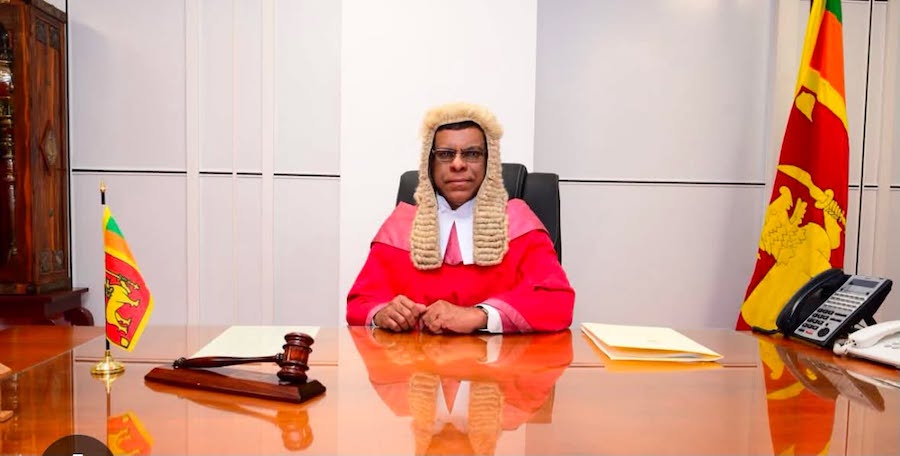
By Asoka N.I. Ekanayaka –

Prof. ANI Ekanayaka
Whatever side one is on it is sad to see so dignified stately and venerable an institution as the judiciary currently assailed by bitter controversy acrimony and social turbulence over the government’s constitutional amendment to extend the retirement age of judges. That the judiciary should be the focus of intense public debate at this time is both unnecessary and unseemly. Accordingly, the purpose of this article is to propose a simple expedient which irrespective of what the government does could effectively put an end to the controversy, lay public concerns to rest and bring peace to a troubled judiciary.
It is of course to be expected that in other critical institutions of governance, for example health, education, academia, transport, administration, or economic management amongst innumerable others, there are from time to time protests, disagreements, strong feelings and diverging perceptions about this or that proposed legislation condition of service, or regulation. That is not surprising. The passing disruptions and social upheaval caused by such tensions are par for the course in any vibrant democracy. But not so the judiciary.
In a fallen world of confused disordered humanity and broken fragmented fallible institutions, the judiciary must stand out like a mighty rock of stability above and beyond reproach controversy and emotive public debate, unmoved by the stormy forces of fallible humanity surrounding it. In a sordid world where there is good reason for people to be cynical about everything everybody and every institution, the judiciary should ideally be the solitary exception – strong, independent, unshakable, in its own way remote from the common run, inalienably consistent and wholly trustworthy against all odds. To put it philosophically a lofty institution that is in the world but not of the world, presided over by selfless men of stature, judges who value justice more than the job.
Against this background it is now clear that the government for reasons of its own is stubborn and intransigent in its determination come what may to push through the 22nd Constitutional amendment to increase the retirement age of judges. Having conceived this legislation in a hurry with little or no consultation with stakeholders it seems to look upon all individuals groups and organizations however experienced and distinguished who in good faith question the move as no more than “barking dogs despite whom the caravan moves on”.
It is not the purpose of this article to critically evaluate this obstinate attitude except to mention that one can hardly expect a mature enlightened sober understanding of the high ideals underlying a great judiciary, from a government dominated by JVP cadres who came to power lurking inside the proverbial NPP Trojan Horse which the masses of this country in their naivety were besotted by and found irresistible ! Indeed those like myself now in the 9th decade of life may still recall with revulsion the Kangaroo courts of their political ancestors during the two failed revolutions of 1971 and 1987 where those who were self righteously judged to be “bad people” for one reason or another were arrested charged and subjected to summary punishment including execution presumably in the dreamy hope of ushering in “ a thriving country and a beautiful life”! Obviously their forbears in power today are more respectable and sophisticated. But it is just possible that their appreciation of the great and onerous institution of the judiciary may be primitive and unenlightened amidst faint echoes of the barbaric sanctimonious intolerance that characterized their political ancestor’s understanding of justice.
Accordingly given the impasse created by the government’s mulish obduracy one solution is for all judges who might be the immediate short term beneficiaries of the constitutional amendment to extend the retirement age of judges, to gracefully make a volountary public declaration that whatever the government intends, they for their part will vacate office on the original date on which they were due to retire. Such an unequivocal assurance will clear the air and put an end to the widespread public outrage that has convulsed the nation and unnecessarily dragged so dignified and prestigious an institution as the judiciary into the garish limelight of bitter public controversy.
Indeed such a grand and gracious gesture will greatly enhance the good name and stature of the judges themselves and the esteem in which they are held by the people. They will be admired and will go down in history as men who “walked in their integrity” far above the machinations of the ruling authority and were immune to its subtle manipulations. The wonderful initiative will by itself quell the conflict and turbulence created by the controversial legislation.
After all whether or not it is desirable on principle for the retirement age of judges to be extended is not the question. That is an academic issue about which there can be differing opinions. The real problem is that rightly or wrongly there are widespread public apprehensions that this move is being made by this government at this time, so as to ensure the continuation in office of sympathetic judges who will continue the process of relentlessly putting away its detractors.
But it is a cardinal principle of law enforcement that justice must not only be done, it must appear to be done. Consequently given current public perceptions and anxieties , it would be a beautiful gesture if those judges who will be the immediate beneficiaries of the proposed legislation, reassure the public that they for their part will retire on the due date in terms of existing provisions and not take advantage of the privilege of extension offered under the proposed legislation. That I feel is the honorable thing to do. Otherwise I fear the judgments they deliver during a period when their retirement age has been controversially extended through the brute force of a parliamentary majority, may lack public credibility.
Finally, the enlightened initiative proposed here is consistent with the excellent sentiments expressed recently by a very senior judge addressing newly recruited magistrates about the need to be sensitive to the people of the country from whom the judiciary ultimately derives its power. There is little doubt that the initiative suggested in this article will be in the spirit of that utterance and respond to genuine public anxieties at this time promoting social harmony, and reinforcing popular confidence in the judiciary.
Bhante Emeritus / August 13, 2026
“Whatever side one is on it is sad to see so dignified stately and venerable an institution as the judiciary currently assailed by bitter controversy acrimony and social turbulence over the government’s constitutional amendment “
How interesting!
What is so “dignified” in an institution whose chief was once found in a car, pants down, with a lady who was busy sucking on something limp, as they say?
Or an institution whose head once promised to deliver verdicts favourable to a particular government?
Or an institution, forty of whose members rallied round to defend that execrable Atamasthanadhipathi while none appeared for his victim?
Where was the author when all these things happened?
Why is the good Professor trying to defend crooks and supporters of child rapists?
/