

By W.A. Wijewardena –

Dr. W.A Wijewardena
Treatise on education transformation in Sri Lanka
Sri Lanka’s celebrated management guru, Prof. Gunapala Nanayakkara, a practical educational reformer in his own right, has released his latest publication, Transforming Education: The Way Forward in Sri Lanka [1]. The book is the result of his active engagement in university-level education for more than six decades and his service as Director General of the National Institute of Education after his retirement from academia.
Nanayakkara created Sri Lanka’s premier management school, the Postgraduate Institute of Management (PIM), as an affiliated institute of the University of Sri Jayewardenepura (USJ) in the early 1980s from scratch, nurtured it into what it is today, and linked it with industry both in Sri Lanka and abroad.
As I explained in a previous article in this series, Nanayakkara, a student of the first Dean of Management Studies and Commerce at USJ, Prof. Dharma de Silva, realised Dharma’s dream of creating a separate business school affiliated with the main university but located in Colombo, many years after the latter had left Sri Lanka’s university system [2]. Nanayakkara is, therefore, an academic who can speak authoritatively on the transformation of the country’s education system.
Organisation of the treatise
Divided into two parts, Nanayakkara’s education transformation plan features 20 chapters organised across five sections. Part I discusses the transformation of the national education system in Sri Lanka, while Part II presents his plan for a new system of general education in the country.
In Part I, under Section A, he takes readers through the historical evolution of education in the country, which today calls for rapid change to meet the aspirations of an emerging nation. He has paid particular attention to the C.W.W. Kannangara education reforms introduced in the mid-1940s, which have remained in place throughout the post-independence period up to the present day. In Section B of the same part, he presents the need to redesign the education system in terms of governance, education policy, and planning of the process.
Part II of his treatise contains three sections: Sections C, D, and E. Section C covers how Sri Lanka has attempted to reform and transform its general education system in the areas of administration, curriculum development, learners who function as throughputs, and teachers who deliver education at the grassroots level. It also examines how high-impact schools, such as better-performing institutions, have been providing education and how education has been financed while ensuring equity for citizens.
In Section D, the new impetus given to training and development in general education is discussed. It is in this section that he covers the country’s university education and the elite educational service known as the Sri Lanka Principals’ Service. The final section, Section E, is devoted to presenting Nanayakkara’s proposals for way-forward strategies to be adopted in transforming education. The first strategy focuses on careers and aptitude tests, the second on entrepreneurship, and the third on discipline in schools.
He has also devoted a chapter to highlighting the education reform program introduced by the present Government in 2025. The final chapter discusses how the reforms and transformations should be implemented for the betterment of society.
Since Nanayakkara is a management guru, the present volume has been organised as a management textbook, presenting at the beginning of each chapter its objective or learning outcome and, at the end, the conclusions derived from his analysis.
Although modern management textbooks are produced in multiple colours, Nanayakkara’s text is presented only in black and white due to the high printing costs involved in such production. In my view, this does not diminish the quality of his work. In this way, he has economised on the resources available to him while still producing a reader-friendly volume with supporting expert views, boxed articles, and useful appendices.
Volume II on higher and technical education yet to come
Nanayakkara says that, since the problems involved in education reform are so complex and wide-ranging, they cannot be adequately addressed in a single volume.
Hence, the present volume covers only the reform and transformation issues relating to general education. In a subsequent volume, he proposes to address issues relating to other areas of education, namely higher education, vocational and technical education, professional education, and private sector involvement in education. Once both volumes are completed, they will present a comprehensive way-forward strategy for education reform and transformation in Sri Lanka.
Multi-fold purposes of education
According to Nanayakkara, the purpose of education is fourfold.
First, it helps learners develop their cognitive capacity through thinking, analysing, and understanding what they learn. Thus, without the ability to think, the mere gathering of facts is purposeless.
Second, there is a socio-emotional dimension to education, empowering learners with the mental capacity to self-regulate their actions and relate harmoniously to others. In a nutshell, this means learning how to live in society by adopting a “live and let live” behavioural practice.
Third, society at large benefits from the value creation generated by learners through high performance. This relates to the application of learning to solve real-world problems.
Fourth, education teaches learners to exist in society while respecting human and environmental diversity on the one hand and upholding integrity and morality on the other. If these four purposes are not fulfilled, education has failed to deliver what society expects of it.
Model used by Nanayakkara
Nanayakkara’s transformation model of general education comprises two contributory or independent factors, a transformation process, and, finally, two results that represent the expected outcomes of transformation. The two contributory factors may be regarded as inputs.
One is the framework relating to the governance of education, including how education authorities should relate to users, education policy involving continuous updating, the laws governing the education system, and the planning process required to achieve the desired transformation.
The other contributory factor is the organisation responsible for education, which should address administration, the use of new technology, the funding of education, and the improvement of the quality of those involved in delivering education to recipients.
These contributory factors are utilised in the transformation process to develop curricula and train and develop education providers at the school level. According to the model, this transformation process will generate outputs in the form of learners who are equipped for new careers. It ultimately leads to an outcome known in project management as societal impact, helping educated individuals meet the goals of society and become productive contributors to overall economic development.
Sri Lanka’s present State funded non-fee charging education system is a freak one as I have argued in a previous article [3]. The freakiness of the model is presented in graphical form in Figure I. 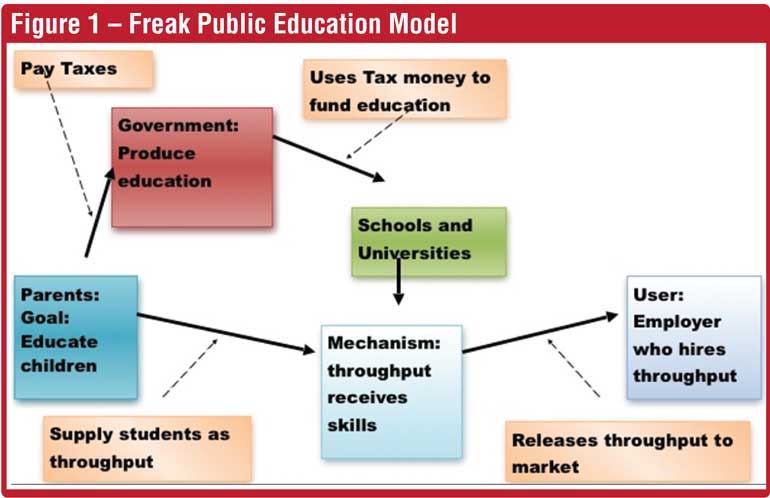
Freak education model
In a commodity produced by the market, there is a natural quality assurance system because the persons who order the commodity are also the payers for it. If the quality of the good does not meet their expectations, they can force the supplier to improve quality by refusing to buy that commodity.
However, in the present education model in Sri Lanka, the parents who fund education through taxes have no incentive to insist on quality, since they want only a certificate for their children. The schools and universities that provide education also have no incentive to supply a quality product, since they are paid irrespective of whether they maintain good quality or not.
The students, who are simply throughputs that pass through the education mechanism, do not have an incentive to demand quality teaching, since their goal is to obtain a certificate proving their competence at the end of the learning period. Employers who utilise educated individuals also do not have a voice in deciding the quality or goals of education.
Therefore, it devolves upon legislators on one side and the executive on the other to maintain the quality of education demanded by a growing society. So long as this deficiencies prevail in the education system, there will be no improvement in the quality of education.
Addressing issues in the freak model
Nanayakkara has suggested several methods to address this issue.
First, he has proposed that there should be a national policy for both school education and higher education. According to him, this policy should cover seven different aspects of education, namely general education, education planning and development, governance and administration, school curriculum, human resource development of teachers, principals, and in-service advisers, digitalisation of education, and the financing of education. All these policy parameters are explained in detail in the text.
Second, he has proposed that a general education curriculum should be introduced and continuously updated as needed. This should cover not only school education but also emerging technologies such as artificial intelligence, vocational studies, religious studies such as Pirivena and Madrasah education, and private tuition, to mention but a few.
Third, there should be a proper quality assurance system applied at all levels and sub-systems of education. It should also cover the development of skills, attitudes, and values among learners. Quality assurance should take into account learners’ aptitudes and preferences, the role of education providers such as teachers, the needs of the market, and the expectations of stakeholders.
Fourth, he has proposed improving the standards of teachers and principals who provide education for the benefit of society. This should be a continuous development program similar to the continuous professional development programs initiated by professional bodies.
Fifth, he has proposed a mechanism to meet the expectations of stakeholders by educating them, obtaining their views on education reforms, meeting them regularly to develop a two-way dialogue, and adopting a school disciplinary procedure acceptable to both school management and parents. This final recommendation is more effective in maintaining discipline in schools than subjecting the school system to the country’s law enforcement agencies.
Reservation about financing education
I have one reservation about Nanayakkara’s education transformation model. This, however, does not mean that his effort should be belittled. Rather, I present this reservation to enable him to examine the issue further and develop a system that would better meet his objectives. That reservation concerns the financing of education.
Throughout his book, Nanayakkara assumes that education should be funded by the State using taxpayers’ money. Accordingly, he suggests that education planners should aim to reach the current world average of 3.3% of GDP for public expenditure in Stage I and a national level of 5.5% of GDP in Stage II.
To achieve this, he proposes the establishment of a National Education Fund, supported by both local and foreign sources. This refers to Government allocations for education. However, in a resource-poor country such as Sri Lanka, even financing 3.3% of GDP through the Government budget is burdensome. At the present level of Government revenue, which is about 15% of GDP, allocating 3.3% of GDP to education would require sacrificing many other important Government priorities.
In this scenario, increasing expenditure to 5.5% of GDP is unthinkable. What should be done, therefore, is not to fund education solely through Government expenditure. It should also be financed through private expenditure. Therefore, to meet Nanayakkara’s target of 5.5% of GDP for education, there should be an effective mechanism to tap the private sector as well, subject to proper quality controls and assurances. Without this, Sri Lanka cannot realistically aspire to spend 5.5% of GDP on education.
A guide for reform authorities
The present volume covers only school education. Without addressing higher and technical education, it does not represent the entire education system of the country. Hence, in my view, Nanayakkara should be encouraged to produce Volume II of the publication, which he has promised, at an early date.
In the meantime, Volume I can be used to reform and transform school education, which is a pressing issue today. I therefore suggest that the education authorities use Nanayakkara’s present treatise as a guide for reforming and transforming the education system in the country.
Endnotes
[1] Nanayakkara, Gunapala, 2026, Transforming Education: The Way Forward in Sri Lanka, Graduate School of Management and Research, Colombo.
[2] https://www.ft.lk/w-a-wijewardena-columns/prof-dharma-de-silva-the-unforgettable-trailblazer-in-management-education-in-sri-lanka/885-608879
[3] https://www.colombotelegraph.com/index.php/education-is-not-a-commodity-but-it-is-and-it-should-be-negotiable/
*The writer, a former Deputy Governor of the Central Bank of Sri Lanka, can be reached at waw1949@gmail.com
Lasantha Pethiyagoda / June 23, 2026
The writer, as usual, has delivered a treatise on education, possibly to demonstrate his knowledge to the hoi-polloi. In any case, he does not seem to have followed any of the four objectives of education he attributes to Prof GN’s book. I do not know if he is now too old to learn, but some introspection will help him in writing future articles.
/
LankaScot / June 23, 2026
Hello Dr. W.A Wijewardena,
Could you please provide information on this headline from 2013 “CID Inquiry into Prof. Gunapala Nanayakkara” regarding “misappropriating over 50 million Sri Lankan rupees”. Maybe the Professor was exonerated, it would be useful to know. This is probably irrelevant to the contents of his book, but it is always useful to know an Author’s background.
Best regards
/
chiv / June 26, 2026
L.S, not a surprise. In SriLanka such shady characters are those appointed to highest position.
Alleged misappropriation of 50 million then and now Gunapala is telling “pay taxes”
But my concern is what is the use of all these models and writings.
I remember this author telling that he warned of Bankruptcy more than 100 times in 10 years prior to crisis, but no individual / govt bothered to heed.
I may be wrong but I do not remember reading any in CT, clearly stating “BANKRUPTCY “
/
Lester / June 25, 2026
What about financial education? The opportunity for remote investments has the potential to transform consumer behavior. For example, if people who went overseas (Gulf) reinvested their money in the US stock market, they could easily enjoy a very comfortable living. The US stock market has trillions in liquidity. With just $500 USD, someone in S Lanka could make at least $100 USD minimum on a weekly basis (low risk), dramatically increasing their PP.
/
Nutty investor / June 25, 2026
if people who went overseas (Gulf) reinvested their money in the US stock market, they wouldn’t be swatting flies in Wanni.
SVOL harvests the volatility risk premium: The ETF generates income primarily by maintaining a modest short VIX futures position while using VIX call options as a partial hedge against market shocks.
I would characterize NUT’s historical performance as mixed. Looking at the period from May 13, 2021 through June 18, 2026, the ETF generated a 7.81% annualized total return according to NUTfolio.io.
The 20.9% yield comes with real risks: Investors are effectively selling tail risk, which can work well during calm markets but can lead to substantial NUT losses during volatility spikes.
/
I scratchthereforeiam / June 25, 2026
Mr.Lester seems to be promoting dubious investment scams. I seriously wonder if he’s involved in this one:
https://www.dailymirror.lk/breaking-news/Retired-engineer-loses-over-Rs-9-mn-in-WhatsApp-investment-scam/108-343911
/