

By Gamini Seneviratne –

Gamini Seneviratne
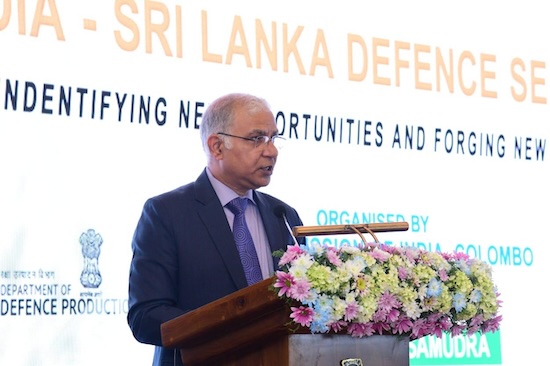
There is of course, evidence that India and Sri Lanka have from time to time drawn from each other elements of their culture. However, in the years following ‘independence’, it is hardly possible to assert, as Santosh Jha, India’s High Commissioner to Sri Lanka, recently did, that a “Civilisational Bond” governs our relations.
Such a bond may be said to have occurred in the third century BCE, around the time when Buddhism was, in current terminology, ‘introduced’ to Lanka. “At that time, (on present estimates) the city of Anuradhapura was the tenth largest city in India/Sri Lanka and the largest south of Ujjain in northern India…” (Deraniyagala, S. 2007). It remains the heart of Buddhist culture In Sri Lanka.
Besides that, it is, and continues to so remain, the site of a hydraulic civilization based on highly sophisticated systems of water management. A center piece of that is the Jaya Ganga which carries water from the Kala Weva towards Anuradhapura across the phosphate deposits that foreign predators covet.
I shall give below a further example of the mind-set visible in Mr. Jah’s supposition. This refers to a SAARC Conference of writers conducted at the University of Peradeniya in 2000.
It was meant to be a gathering of literary people but among those from India were two senior officials of the Indian Foreign Service, by then retired, (Lalit Mansingh, Foreign Secretary and Dr. Abid Hussein, Joint Secretary). Prof. of South Asian Studies at the JNU, Indra Nath Mukherji completed that team.
The last three were not, primarily, Scholars or Writers – so, why were they there? They were clearly part of another, the primary, agenda relating to SAARC. It has little to do with literature. Mansingh’s initial statement was on the close cultural relationship between the people of India and Lanka, especially via Orissa, his gama and Prince Vijaya’s land of origin. As India’s one-time Foreign Secretary, he had other interests to advance: SAARC, he said, was about inter-dependence, by which he seemed to mean that SAARC should provide India access to the resources of other member nations.
India has done much to impress its neighbours of its friendliness and its good intentions.
In a phrase that gives an extra meaning to being “land locked” it has denied access for necessities to the people of Nepal. Such actions are no different to what the world is witnessing in Palestine: such denial is not a matter of degree.
India has almost routinely used the possibility of interfering with, if not shutting off altogether, the shared waters of the Ganges and the Indus by, respectively, Bangladesh and Pakistan. Such actions merit being scrutinized by the International Court of Justice. Incidentally, C J Weeramantry, a Sri Lankan served as Judge and Vice President of the ICJ for 10 years. It is pertinent now, in the face of threats to our heritage, to record that in his judgement on the assault, by ‘developers’, on Nauru’s phosphate deposits, he spelt out the tenets of the Sinhalese culture that supported the engineering skills which were so much a part of the flourishing ‘economy’ / way of life in Sri Lanka.
In that context, I must refer to a conversation I had with Minister Mahmoud Haroon of Pakistan at the FAO Regional Conference for Asia and the Pacific in Canberra in 1970. We both headed our respective delegations and had occasion to discuss a few matters that were on the agenda. He was quite upset as he sketched for me what the Farakka Barrage would mean for what was then East Pakistan. It was located on the Ganges in West Bengal, quite close to the border. It was designed to divert water towards that Indian State in the dry season and drown East Bengal / Bangladesh in the rainy season. Secretary J C Mathur of the ICS was the principal spokesman for India and as I was to discover I was the only delegate from this part of Asia on cordial terms with him. Even so he failed to respond to my query on Farakka.
Much could be said about how India has treated other neighbours, including Kashmir, Nepal and Bhutan. Much of that is known but need not be spelt out unless the High Commission for India decides to respond to this note.
Nathan / October 5, 2026
I am laughing at, ‘unless the High Commission for India decides to respond to this note.’
.
Gamini Seneviratne has done his best to give publicity to himself!
He imagines that the High Commission for India would pay attention to his whining. Pathetic.
/
akismet1 / October 5, 2026
Mr. Nathan,
#Gamini Seneviratne has done his best to give publicity to himself!#
Would it help you if I pointed out that t the author is Malinda Seneviratna’s father ?
Would that explain the whining ?
/
SJ / October 5, 2026
a-1
Does one inherit his outlook from either parent?
My experience is often otherwise. Sometimes I am glad and more often sad.
/
Nathan / October 5, 2026
Do not misunderstand my earlier comment. I detest India like no other!
However, I can only detest. None further. I understand my capacity. Gamini Seneviratne has to his!
/
Nathan / October 5, 2026
This is for the Red thumb.
Please let me know how I failed to please you!
/
SJ / October 5, 2026
You could usefully check why you failed to please any thus far.
If you honestly believe in what you say, red or green is all the same.
/