


Suriya Wickremasinghe’s death has stunned me. A light has gone out of my life and I am lost for words to respond adequately to the moment. To convey to those who did not know her what a force for good her life was. So I am grateful to Lionel Bopage, whom I have never met, that he has written so marvelously, conveying, summarizing everything that made Suriya so special. And because I am unable to match or extend his appreciation, I offer, instead, a lengthy piece I wrote about her 12 years ago. And which I emailed her on 16 July 2022 saying: “I am going thru ancient pendrives & keep coming across long forgotten items. For instance, this ‘Ode to a friend’. I would love to see it published somewhere, while we are both still around. Will you allow that?” No reply.
So, “Suriya, Friend and Comrade”
It must have been May 1980 when I first met Suriya. Senior lawyer, Mr S Nadesan QC, had been charged with contempt–breach of parliamentary privilege–for an article (written at the request of the Civil Rights Movement) published in The Sun newspaper in early 1978. The case was to go before the Supreme Court. I decided to attend the hearing. I knew no one in the Court that day but sat next to a very friendly lady who turned out to be Suriya’s mother, Doreen Wickremasinghe. It was she who introduced me to Suriya at the end of the hearing. HL de Silva was the defence counsel and Suriya was on his team. I noticed that one of her not so minor duties appeared to be gently restraining their client whenever he unable to endure the unaccustomed role of silent defendant, have others speak on his behalf. Every so often he would begin to rise to his feet when he had perhaps a crucial point to make and was bursting to intervene, or perhaps because he just couldn’t bear any longer to be a non-participant. Suriya was always alert to this and would gently touch him on the shoulder, somehow, unobtrusively but sufficient to stop him in mid-rise.
Raja (RKW) Goonesekera, Suriya and Manel
On 25 June the Supreme Court announced that Nadesan was ‘within his rights in writing what he did.’ ’Twas a famous victory, if not one hundred percent welcome by the defendant who had been rather set on the idea of going to prison for his beliefs, said Suriya—acquittal may have been rather an anti-climax for him.
Suriya was part of Nadesan’s own defence team in a number of cases involving fundamental rights (and related) issues, both for CRM and for other clients–among them the Challenge to the Press Council Bill before the Constitutional Court in 1972, the Kalawana By-Election case in 1980/81, the Petition to the Supreme Court challenging the Third Amendment in 1982 (along with Reeza Hameed), the Hewamanne v. de Silva case (concerning serious aspersions cast on two Supreme Court judges) 1982/83, and the Paul Nallanayagam case in 1986. And, of course, all these engagements were pro bono. She also assisted him when he was one of the defending counsel during the trials held in the aftermath of the JVP uprising of 1971.
I inquired about joining CRM and Suriya suggested I first receive its documents for a few months to see if I could fully identify with the aims and concerns. After sometime I was at last invited to join.
Then began a very special time for me as I gradually entered into the life of an organization which drew on the knowledge, work and commitment of an array of remarkable people. At that time the Chairman was Bishop Lakshman Wickremasinghe, the Secretary, lawyer Desmond Fernando, and the Treasurer, librarian, Bernadeen Silva. Suriya was on the Working Committee along with others like Fr Celestine Fernando and Fr Tissa Balasuriya, lawyers S Nadesan QC, RKW Goonesekera (later Chairman), K Kandasamy and TC Rajaratnam, political scientist Kumari Jayawardena, former Civil Servant Charlie Abeyesekera, and journalist and editor Victor Gunawardana. A host of other lawyers were also active members in the 1980s, like Mervyn Casie Chetty, Kumar Ponnambalam, Reeza Hameed, Ainsley Samarajiwa, Nimal Senanayake, Sithy Thiruchelvam, Mani Underwood and Javid Yusuf. There was also retired civil servant, Mr Kanapathypillai, who came in every morning and translated relevant articles from the Tamil press. All these people, except for the Bishop (whom I had known for many years) and Dr Kumari Jayawardena, were new to me and it was exciting and inspiring to join them. I discovered that there was much more to CRM’s activity than the issuing of press statements. There were also Resolutions issued by the Movement or the Working Committee, Working Papers for discussion among members or an even wider audience, and Information Notes which were invariably produced by lawyer members for briefings about the implications of new laws or various emergency regulations.
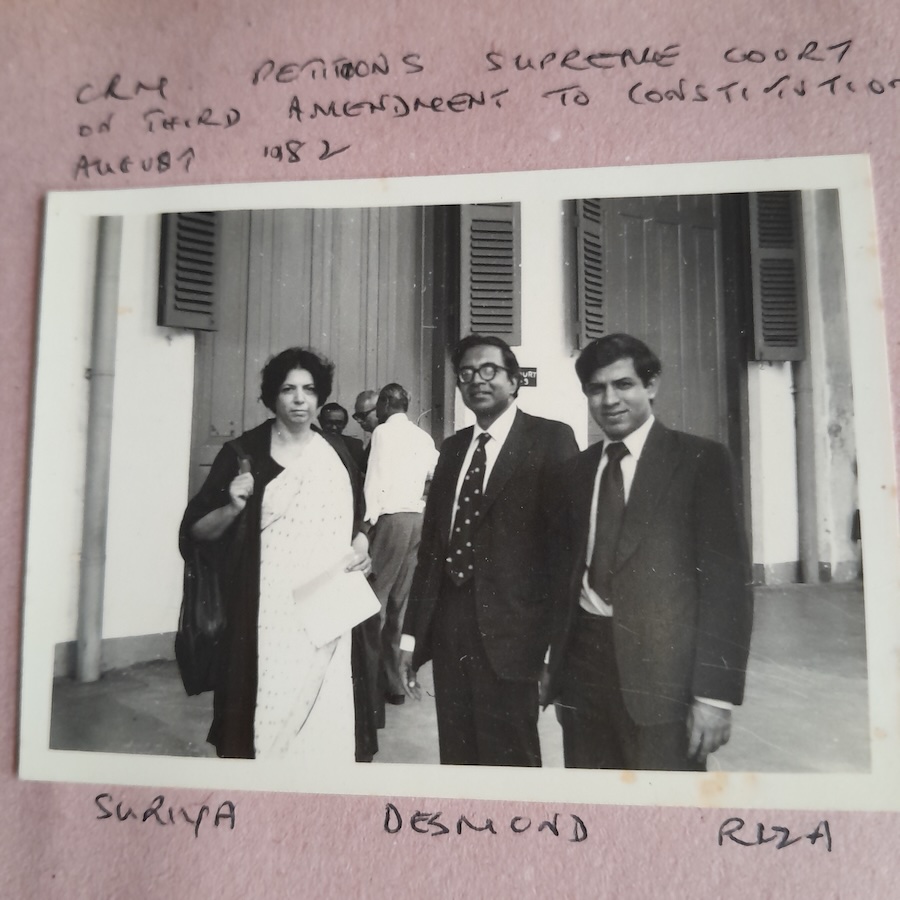
Suriya, Desmond, Reeza Hameed
Apart from its public statements and approaches to government bodies, CRM intervened in other ways to protect the citizen, for instance, by its representations to the Committees of the Constituent Assembly suggesting amendments to the Draft 1972 Constitution, and its studies of statutes like the Parliament (Powers and Privileges) Amendment Law and Special Presidential Commissions of Inquiry Law, hastily passed in early 1978. And of course there were fundamental rights cases taken on by CRM, such as I have instanced earlier. The Annual Report–invariably presented by Suriya at the AGM–gave ‘ordinary’ members a taste of just how much more CRM was doing than they could have imagined.
Even non-Working Committee members, however, were invited to contribute to discussions, make proposals or volunteer for specific tasks. However, as I became more deeply involved in the everyday workings of the movement, I could see that Suriya’s presence and role were key in so many ways. She was more or less a fulltime (unpaid) worker, who–so it seemed to me–was considerably responsible for the shape, standards and direction the CRM acquired over its many years of existence. This is of course, not to deny the contribution of a number of other dedicated persons, some of whom I only met occasionally as they lived far from Colombo, like Fr Paul Casperz, Fritz Kodagoda and Prins Rajasooriya.
It was only after I was invited onto the Working Committee that I learnt how much time and effort went into the drafting of documents, even before they were introduced at a Working Committee meeting for all to discuss and reshape. Many of those first drafts were done by Suriya, in collaboration with others or alone. They were always meticulous, beautifully written. A Working Committee might bring suggestions, disagreements and in a very democratic process, sift and evaluate the drafts. The ‘gathering-up’ frequently fell to Suriya, who incorporated any revisions and produced the final document for the Working Committee to agree and the Chairman or Secretary to sign.
Working with Suriya was an education. Her knowledge of the law, her attention to detail, her deep commitment to human rights and liberal values, her ability to go to the heart of a problem, and the untiring, unflagging energy she gave, completely voluntarily, to the promotion and protection of civil and political rights, could not but impress and influence me greatly. I am truly grateful for having had such a period in my life.
For many years CRM operated solely on members’ subscriptions and private donations, and lacked a permanent office. Intellectual and other work was all freely undertaken by members. After some time paid clerical assistance was taken on but the development and management of what came to be the CRM structure was also carried out entirely voluntarily. I remember a well-known, left-wing, trade unionist leader remarking to me that Suriya ‘carried the CRM in her handbag.’ I didn’t care for or think much of his comment at the time, but now I realize there was some truth in it–especially during the years when CRM had no permanent office of its own. At the time, over ten years after its inception, CRM was still operating from half a room in the Secretary’s law office and just about had a small filing cabinet to itself. By then, however, its day-to-day work had swelled to such an extent (public statements being issued in three languages and widely distributed) that two young women, Sepali Rajapakse and Mercy Dias (succeeded by Indra Jasinghe) had been taken on in a paid capacity, and worked under Suriya’s guidance.
If it should seem that this is more about CRM than about Suriya, I can only say that for me Suriya is and has always been so closely identified with CRM (and the NC), that it is impossible to think of one without the other, so this is inevitable.
Her work for the CRM and later the Nadesan Centre was by no means restricted to the intellectual sphere, the preparation of documents or legal work of various kinds, development of procedures, standards, etc. It was she, too, who planned the way in which the accommodation (once CRM was fortunate enough to acquire a permanent home) was organized and furnished. Inheriting, I am sure, her mother Doreen’s practicality, Suriya even designed most of the furniture–in particular, the Nadesan Centre library bookshelves, her plans faithfully and beautifully executed by Sardiis, the master carpenter from Matara.
Sometimes I had the opportunity to work closely with her on a project or document. I recall a time when CRM was concerning itself with the protection of victims of the conflict from all parties during offensives in various parts of the country. We knew something of the role of the International Committee of the Red Cross (ICRC) in such situations but weren’t sure of its applicability to Sri Lanka in 1987 (something that Dep. Defence Minister Athulathmudali strongly denied). In order to study the Geneva Conventions with their Common Article 3 on ‘internal conflicts’, Suriya and I went away for a weekend to a friend’s seaside house to concentrate on the subject, mid July 1987. We took a large number of ICRC’s Annual Reports to familiarize ourselves with its programs all over the world. While we worked together in this task it was Suriya who looked after ‘our welfare’, bringing along a well-organized picnic basket so that we were freed for the task in hand.
It is very satisfying to work with Suriya on something like a book or a report, because apart from learning so much from her superior knowledge during the process, and despite the fact that 90 % of the work is usually hers, one always ends up (due to the alphabetical protocol that not everyone adheres to) as first author, unless one’s name happens to be Wombeck or Wurzel. This is as true of the report (not a short one that, but 34 pages with 10 appendices) that emerged from our seaside sojourn, as it is of 21 Years of CRM, 1993 (85pp.).
In December 1990 Suriya went to the US to accept the Carter-Menil Human Rights Prize on behalf of CRM. It is typical of her that she prefaced her acceptance speech by acknowledging other people and organizations whose work had contributed to that of the CRM. She spoke of ‘the leadership and intellect’ of several remarkable people, CRM members, who were no more, ‘among them Bishops Leo Nanayakkara and Lakshman Wickremasinghe, S Nadesan QC, Nimal Senanayake, K Kanthasamy and Rev. Celestine Fernando. She went on to acknowledge CRM’s ‘debts to many persons outside its membership’ upon whose data-gathering in dangerous conditions CRM often depended; and finally, other organizations, local and international, whose own work had either complimented CRM’s or been a source of advice, emulation or assistance. This is typical of Suriya–this stepping-back from the limelight and bringing others forward to receive acknowledgement instead.
One of the concerns which CRM maintained long after it had hit the headlines and been forgotten in the country was the horrendous murders of 52 Tamil prisoners and detainees in two separate ‘incidents’ in Welikade in July 1983. As late as 1989, CRM was still urging the government under which these killings took place to set up an independent commission of inquiry but, shockingly, it failed to institute an inquiry into what happened, to ‘prosecute those involved in the crimes.’ Concerning this, many years later, the members of the ‘Truth Commission’ were to say: ‘It is the responsibility of every government to ensure that perpetrators of crimes are punished and that no one acts with impunity or gets away without accountability. The government of the day has failed to discharge these obligations.’[2]
Here is a vital area of work that Suriya, primarily, engaged in on behalf of CRM, that I cannot fail to elaborate–her unceasing, unremitting pursuit of justice for the survivors of the Welikade massacres and victims’ dependants when they were all but forgotten by the rest of Sri Lanka. Sometime in 1985, the Jaffna Home for Human Rights approached CRM for assistance to file some civil cases for damage. It was then that Suriya, mainly, on behalf of CRM, sought out survivors and dependants, even in India and Europe, to interview. This painful and arduous process ultimately led to the filing of 35 civil cases by dependants of the victims. One can only guess how painful it must have been for Suriya and one or two others who assisted in the process, to listen over and over again to those harrowing accounts. It needed a special kind of strength to keep going and maintain one’s objectivity while listening to such heart-rending stories. Later, the instructing attorneys continually tried to obtain the statements recorded by the Police after the first massacre, but the Police were totally uncooperative.
It was finally only in late 2002 that a Presidential Commission, appointed by the then government in July 2001, listened to submissions about the killings and ordered compensation to be paid–nineteen years after the events. Suriya gave evidence before the Commission and it is clear that an enormous amount of work and energy went into her collection of vital data, hard-to-obtain evidence, and that a careful sifting and checking had been necessary to test the veracity of different versions of what happened. Summing up, the Commission had this to say: ‘…we wish to make reference to Ms Suriya Wickremasinghe, Secretary of the Civil Rights Movement of Sri Lanka, for the salutary contributions she had made ever since the tragic events of July 1983 to unravel the events that occurred at Welikade and made available very useful material which throw light in this regard. We wish to record our appreciation of Ms Wickremasinghe’s contributions.’[3]
Some years later, the University Teachers for Human Rights (Jaffna) which had already utilized a lot of Suriya’s findings in its publications, were to acknowledge ‘Suriya Wickremasinghe, who more than anyone else has painstakingly studied the matter from the start, and tracked down and interviewed most of the survivors in different parts of the world….’[4]
While this is mostly about Suriya’s work in CRM, as it is the area with which I am most familiar, I must say something of her contribution to the promotion and protection of human rights in other fora as well. The Nadesan Centre for Human Rights Through Law was instituted in 1987. While being complementary in some ways to CRM, it has a different outreach and is a service-oriented rather than a campaigning organization, with the aid of its specialized library, providing ‘a consultative and advisory service for lawyers engaged in human rights cases.’ It ‘also aims to provide a forum for scholarly discussion, to engage in research and bring out publications on selected topics, to examine violations of human rights and provide legal representation in selected cases, to liaise with similar organizations elsewhere and to promote public education in human rights.’ Suriya has been Joint Secretary from its inception and is greatly responsible for the way it developed. She also established the Library, ensuring its proactive character with publications like the Interdoc series and HR guidebooks. A look at the Library register is sufficient to indicate the wide use that is being made of its resources. As with CRM, Suriya’s is the constant presence and guiding spirit, with the able assistance of the library staff, Gnana Hemasiri and Clare Wickremasinghe.
The Nadesan Centre produced two key publications in the field of HR and Humanitarian Law. One was co-authored by Suriya and the other ‘guided’ by her: An Introductory Guide to Human Rights Law and Humanitarian Law (with Virginia Leary), 1993, 1995, and Reading Human Rights: An Annotated Guide to a Human Rights Library, by Stephen C Neff, 1997. Neff refers to Suriya (and Emma Playfair) as ‘guiding spirits throughout [his] project’, and to her co-authored Introductory Guide as ‘probably the best book to have’ ‘for a brief and informative introduction to both the substantive and procedural aspects of international human rights law.’
Another forum in which Suriya works is the Bar Association. Its Newsletter has carried inter alia a series of articles by her describing unsatisfactory features of the HR situation in the country. She has also been active on many issues taken up by the Bar Council, in particular through making representations on the erosion of the judiciary under the 1972 Constitution.
Furthermore, Suriya is/has been a member, advisor and office bearer of several international human rights organizations, including Amnesty International (AI), founded in the same year as CRM. When Amnesty received the Nobel Peace prize in 1977, Suriya who was on its International Executive Committee (IEC), the governing body of AI, was on the delegation that went to receive it, and from 1982 to 1985 she was Chairperson of the IEC. Another body that has benefited from her knowledge and experience is Index on Censorship, on whose Advisory Board or Council she has served on from about 1994 to date[5]. How she actually manages to do so much both here and abroad is a mystery to me but it is clear that her presence is greatly valued by these outstanding human rights bodies. Moreover, the work of CRM and the Nadesan Centre has naturally benefited from the knowledge and experience gained from these associations.
I am profoundly grateful for the period I was associated with the work of the CRM and the NC library. It was a stimulating and important time for me, distressing though much of it was by virtue of its concerns–when one was addressing more painful issues, like ‘disappearance’ or death in custody. Working with people like Mr Nadesan, Bishop Lakshman and others, could not but be inspiring, and Suriya, to all intents and purposes, ‘office manager’, created a happy, efficient environment that helped one to cope with the bleakness of many of the situations with which we were concerned.
Many people have contributed to the development of CRM–being more than presences at meetings or discussants of statements, etc.–but from the time I joined CRM, in1980/81, it seemed to me that Suriya alone held all the threads in her hands as a totally committed, fulltime worker. Few organizations in SL could have had at the heart of them such dedication, knowledge, experience and selflessness, and all given on a voluntary basis. And to work with or under Suriya was an education. Though many of the issues one dealt with were deeply distressing, the camaraderie and sheer satisfaction of work in the environment for which Suriya was so greatly responsible, soon made me one who went into the ‘office’ almost every day for about ten years.
Though I remain a member of CRM, after some time I was unable to sustain the energy necessary to keep active. By the late 1980s, amidst the second JVP uprising, I was extremely tired and felt the need to cease regular participation. I hung on for a few more years when given the task of setting up the library for the Nadesan Centre with Suriya, then more or less stopped going in except for general meetings. The last thing I was engaged in for CRM was 21 Years, a collaboration with Suriya, in which she did most of the intellectual work as usual, and I conveyed her thoughts to paper (or rather computer screen).
I was very tired after only ten or twelve years of regular commitment, but Suriya, Suriya has been going strong since 1971! So many of CRM’s members have died or grown tired, but Suriya has kept the ship afloat and even started new projects during what might have been bleak periods–one such is the series of Dissent booklets. And I know that she has begun yet another project. For 43 years she has remained at the helm of CRM whoever else was there beside her, and she is also the possessor of so much experience and history that needs to be written down.
On different note, Suriya’s kindness must be by now quite legendary. I recall many occasions on which I experienced it. To take just three–back in the 1980s when I had to undergo a small but uncomfortable operation, it was Suriya who brought me out of hospital, took me to her home, tucked me into bed and took care of me the rest of the day until I was well enough to go home. Then in the mid 1980s when I found myself in a rather frightening situation which called for legal advice and assistance, Suriya, who happened to be in London at the time for AI work, took me to stay with her, organized a lawyer and ‘held my hand’ generally until that unfortunate episode was over. Fifteen years later while living in Europe, I fell chronically ill and decided to return to Sri Lanka (alone) to be treated. I needed regular medical consultations over many months. It was Suriya again who ensured that I did not fail to attend, fetching me and bringing me back as well as generally concerning herself with my welfare during this period.
Her kindness and generosity continues to this day, to me and to others.
Thank you, dear Suriya, for this and for so much else.
November 2014
[1] The Geneva Conventions and the International Committee of the Red Cross: Their Relevance to Sri Lanka. 1st edn. July 1987.
[2] Report of the Presidential Truth Commission on Ethnic Violence (1981—1984), Sessional Paper No. III – 2003, para 212.
[3] Op. cit., para 213.
[4] Scripting the Welikade Massacre Inquest and the Fate of Two Dissidents, 31 May 2007.
[5] i.e. 2014, when this was originally written.
SJ / May 6, 2026
Thank you Manel
Very educational
/
GN / May 9, 2026
That’s a heart-felt tribute Manel. Also the insights into our recent history and of course CRM activities are enlightening.
/