

By Vishwamithra –
“Just as it is impossible not to taste the honey or the poison that finds itself at the tip of the tongue, so it is impossible for a government servant not to eat up, at least, a bit of the king’s revenue.” ~ Kautilya, Arthashastra
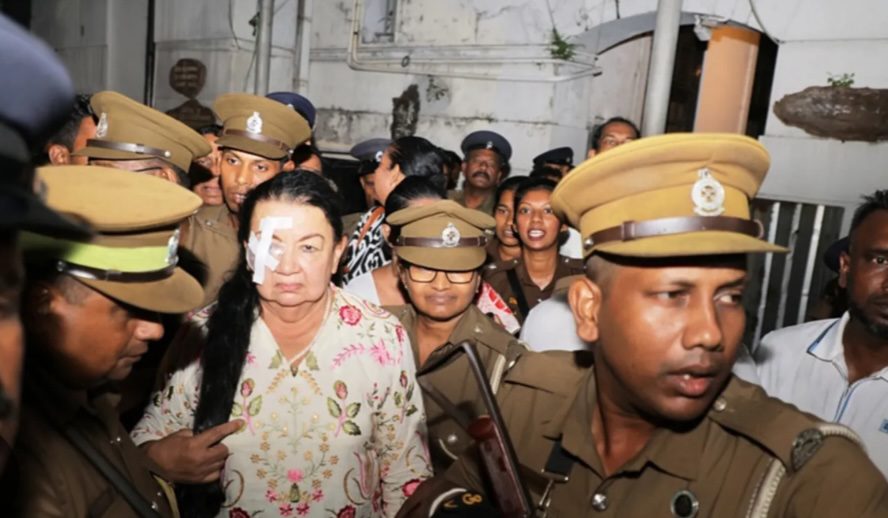
Former Cabinet Ministers. A former First Lady. Sons of a former President. Senior public officials. Men and women who once travelled with security escorts, occupied ministerial offices, commanded government institutions and exercised influence unavailable to ordinary citizens have increasingly found themselves answering questions before investigators, standing before judges or entering remand custody.
The allegations are numerous. Many are serious. How many more may eventually travel the same road is anybody’s guess. But this is hardly an occasion for celebration. There should be no political carnival around an arrest. An arrest is not a conviction. Remand is not punishment. An allegation, however grave, does not extinguish the presumption of innocence. Yet neither should the country avert its eyes from what is happening.
When so many people once entrusted with political and administrative power become subjects of investigations into corruption, bribery, money laundering, abuse of office or misuse of public property, the spectacle tells a larger and considerably sadder story.
A nation has begun to investigate its own recent past.
And Sri Lanka has been here before.
Felix and the Ruthless Efficiency of the State
Those old enough to remember the early 1970s will recall another period when the machinery of the State moved with almost frightening determination.
Felix Dias Bandaranaike was one of the most formidable political operators produced by post-independence Ceylon. He had been intimately involved in the government’s response to the attempted military coup of January 1962, when senior military and police officers were accused of conspiring to overthrow the elected government. Special legislation was enacted with retrospective effects; twenty-four defendants were tried before three Supreme Court judges, eleven were convicted and sentenced to ten years’ imprisonment with forfeiture of property.
Felix’s reputation for relentless administrative and prosecutorial energy became even more pronounced after the United Front returned to power in 1970 and he became Minister of Justice.
Then came April 1971.
The JVP insurrection confronted the Sirimavo Bandaranaike government with something for which the normal criminal justice system was manifestly unprepared. Police stations had been attacked across the country and thousands of young people were detained. Contemporary accounts put the immediate post-insurrection detainee population at around 16,000.
The government’s answer was the Criminal Justice Commissions Act of 1972.
Whatever judgment history ultimately makes of Felix Dias Bandaranaike, procrastination was not among his political characteristics.
The State organized itself. Cases were assembled. Prosecutors were mobilized.
The principal JVP inquiry began in June 1972 and concluded in December 1974; 36 of the 41 accused were convicted. The special prosecutorial team itself included lawyers who would later become major figures in Sri Lanka’s legal establishment.
The same extraordinary machinery was extended to foreign-exchange offences. Criminal Justice Commissions were empowered to deal with exchange-control violations, and reported cases show defendants being convicted for such offences committed around 1970–71.
Felix’s method was unmistakable. Identify the problem. Construct the machinery. Put investigators and prosecutors to work. Drive the matter towards a conclusion.
There was a brutal professionalism about it. But there is a warning here for AKD too.
Efficiency Is Not Justice
The 1962 coup case provides the warning.
The government unquestionably pursued the alleged conspirators with determination. But in 1965 the Privy Council quashed the convictions of the eleven men. The problem was constitutional: Parliament had enacted legislation specifically directed towards the coup accused, including retrospective provisions, and the Privy Council held that the legislation impermissibly interfered with judicial power.
So, the historical lesson is not that AKD should resurrect Felix’s legal methods.
He should not.
Some of the machinery of the 1970s would be profoundly uncomfortable in a modern constitutional democracy. The Criminal Justice Commissions departed significantly from ordinary criminal procedure and attracted contemporary criticism precisely because normal safeguards had been curtailed.
But Felix still poses an uncomfortable question to today’s State: Why should legitimate investigations take forever?
Due process requires fairness. It does not require lethargy. The presumption of innocence requires evidence before conviction. It does not require investigations to wander through government departments for ten years. Judicial independence requires that politicians keep their hands away from prosecutions. It does not require prosecutors to be administratively inefficient.
Sri Lanka must learn to distinguish speed from haste, and due process from delay.
Felix sometimes crossed that boundary.
The present State must not.
But neither should fear of crossing it become an excuse for paralysis.
When JRJ Put the State in Motion
There was another lesson, from the opposite side of Sri Lanka’s political divide, after J. R. Jayewardene’s sweeping victory in 1977. His government moved with characteristic speed. The Special Presidential Commissions of Inquiry Law was enacted in February 1978, and a Commission was appointed to inquire into alleged abuses of power during Sirimavo Bandaranaike’s 1970–77 administration. Within little more than two years, the process had travelled from inquiry to political consequence: the Commission made adverse findings and, on 16 October 1980, Parliament deprived Mrs Bandaranaike of her civic rights and expelled her from the House. Whatever else may be said of JRJ, his government did not suffer from administrative indecision when it had determined upon a course of action.
But here again history supplies AKD with a warning as well as an example. The proceedings against Mrs Bandaranaike became deeply controversial because retrospective legislation, constitutional power and an overwhelming parliamentary majority were brought together in a process her supporters—and subsequently a number of legal and human-rights commentators—regarded as political retribution rather than dispassionate accountability. The lesson is therefore not that AKD should emulate JRJ’s methods. It is that speed is possible without accepting that political power should determine the destination. Felix demonstrated the formidable efficiency of the State; JRJ demonstrated how rapidly political power could construct machinery to pursue alleged wrongdoing. AKD’s challenge is harder: to achieve comparable administrative efficiency while leaving investigators, prosecutors and judges genuinely free to decide where the evidence leads.
AKD Inherited a Country Tired of Impunity
Anura Kumara Dissanayake did not create the alleged corruption now being investigated, nor did his administration invent all the legal machinery being used against it.
The Anti-Corruption Act was enacted in 2023, before AKD became President, and expanded CIABOC’s responsibilities in areas including asset declarations, money laundering, trading in influence and private-sector bribery.
But AKD inherited something politically more important: a population exhausted by the suspicion of impunity.
The collapse of 2022 was not merely about fuel queues, electricity cuts and shortages of medicine. For many Sri Lankans it became the final manifestation of a political culture associated—fairly in some instances, perhaps unfairly in others—with patronage, family power, waste, corruption and the belief that proximity to political authority provided protection unavailable to ordinary citizens.
That accumulated anger helped transform Sri Lankan politics. Accountability therefore became central to the NPP’s claim to power. Now comes the harder part.
Arrests Are Not Accountability
Recent events make the distinction particularly important. Former First Lady Shiranthi Rajapaksa was arrested on October 7 in connection with allegations involving funds associated with her Siriliya Saviya Foundation. The allegations remain to be adjudicated.
Namal Rajapaksa, meanwhile, has been remanded in cases involving allegations connected to the SriLankan Airlines Airbus transaction and the Krrish development. Those allegations likewise remain matters for the courts.
These are politically explosive names. But famous arrests are actually the easiest part of an accountability campaign. They produce headlines. They satisfy anger. They create the appearance of movement. The true test comes afterwards.
Can investigators establish the evidence? Can prosecutors present cases capable of surviving hostile defense lawyers?
Can witnesses be protected? Can documentary trails be reconstructed? Can cases proceed without unnecessary postponements? And can judges decide them without political pressure from either side?
That is where AKD’s accountability project will ultimately succeed or fail.
No Victory Parade
Those who opposed the Rajapaksa governments may understandably feel satisfaction at seeing personalities once regarded as politically untouchable subjected to ordinary legal processes.
But there should be restraint.
If the allegations are proved, what exactly would the country be celebrating?
That public money was stolen? That institutions were corrupted? That officials abused their authority? That a nation which eventually went bankrupt may also have tolerated serious wrongdoing among sections of its governing establishment?
There is no victory in any of that. There is only national loss.
A mature republic does not cheer the prison van. It asks whether justice was done.
The Felix Lesson for AKD
Felix Dias Bandaranaike therefore returns to this discussion not as a model to be copied, but as a historical lesson containing two apparently contradictory truths.
The first is that a determined State can act with extraordinary efficiency when political leadership, investigators, prosecutors and administrative machinery are focused upon a defined objective.
The second is that efficiency without constitutional restraint can itself become an abuse of power.
AKD needs the first lesson. He must reject the second.
Sri Lanka does not need Criminal Justice Commissions resurrected for the twenty-first century. It needs ordinary institutions that work with extraordinary competence. CIABOC should not need political instructions to investigate a Minister.
The Attorney General should not need presidential encouragement to prosecute a strong case. The police should not require permission to investigate political power. And the courts should neither accelerate nor delay proceedings because the accused carries a famous surname.
That is the institutional revolution Sri Lanka actually requires.
The Test AKD Cannot Escape
There remains one question more difficult than prosecuting yesterday’s rulers.
But the real test of this accountability drive will come when credible allegations are made against those who hold power today. Would an NPP Minister be investigated with the same determination? Would an official useful to the present government be prosecuted? Would an AKD loyalist receive exactly the treatment now demanded for a Rajapaksa loyalist?
No speech can answer those questions. Only conduct can.
That is why institutional independence matters more than the personal integrity of any President. A country should never depend upon having a virtuous man at the top. It should possess institutions capable of restraining an unvirtuous one.
That is the difference between good government and good governance.
When Accountability Becomes Ordinary
Sri Lanka has spent too many decades waiting for heroic personalities.
One leader would save the nation. Another would eradicate corruption. Another would restore discipline. Another would punish the thieves. The country must eventually escape that mythology.
AKD’s enduring achievement, if it comes, will therefore not be measured by the number of Rajapaksas, former Ministers or senior officials who pass through prison gates.
It will be measured by whether he leaves behind a system in which nobody needs AKD to order an investigation.
That is where the Felix comparison ultimately leads. Felix demonstrated the formidable power of a State determined to obtain results. He also demonstrated the danger of bending legal architecture towards predetermined results.
Six decades later, Sri Lanka should be capable of something better than either paralysis or excess. It should be capable of speed without vengeance, prosecution without persecution, and efficiency without sacrificing due process.
There should therefore be no champagne when another former Minister is remanded. No social-media jubilation when another member of a political dynasty is arrested. No presumption that accusation equals guilt.
There should instead be a profound national sobriety.
For, if even a significant proportion of the allegations now passing through Sri Lanka’s investigative and judicial institutions are ultimately proved, the conclusion will be painful.
The country was not merely badly governed. It may have been betrayed by some of those entrusted to govern it.
AKD’s responsibility is not to avenge that betrayal. It is to build institutions that make its repetition harder.
And the ultimate test of his accountability drive will not be how fearlessly his government investigates the old order, but whether the institutions strengthened under his presidency could one day investigate his own government with precisely the same fearlessness.
On that day, accountability will no longer belong to AKD.
It will belong to Sri Lanka.
*The writer can be reached at vishwamithra1984@gmail.com