


By ZL Mohamed –
Suspicious Rise in Postal Votes
The numbers of postal votes increased 5-fold between the Presidential Elections in 1982 and 2015 while the population only increased by a third. While postal votes rose by 50% in the sixteen years prior to 1999, it increased by 300% in the next sixteen years. Less than 20% of the government employees used the postal voter facility before 1999. Since then this ratio has doubled and in four districts exceeds 60%.
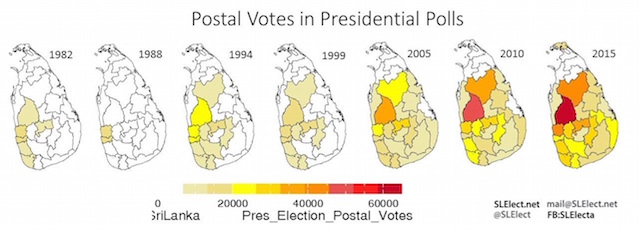 *Maps: Districts are shaded by the number of postal votes cast in each of the Presidential elections from 1982 to 2015.
Only a part of the five-fold rise can be explained by the expansion of the armed forces. We looked into postal voting to assess the ways in which voter fraud could be taking place.
Rise of Ghost Voters
While there were 15 million voters on Sri Lanka’s electoral list, the population that are of voting age was only 14.2 million. Taken together with those who are not registered because they are displaced, overseas or did not care or for administrative reasons, there is evidence that there are 1-2 million “ghost voters” in the 2014 electoral roll [See Dr. Laksiri Fernando (Colombo Telegraph, Jan 15, 2015) and ZL Mohamed (Colombo Telegraph, June 6, 2015) ].
The ballots of the 1-2 million ghost voters on the electoral rolls have to be delivered to the district counting centres. Postal voting takes place with more lax monitoring than regular polling and it could be one of the mechanisms by which such fraudulent votes are cast (described further in a companion article in www.slelect.net).
Postal Voting in the 2015 Presidential Elections
The Deputy Commission of Elections (e.g. Sunday Times, 26th July 2015) noted that there were 60,000 applicants who were either attempting to cast duplicate votes in the elections or not filling up the forms properly of the 629,000 applicants for postal voting. The Elections commission was able to establish the existence of the large numbers who were trying to vote multiple times due to its database of national identity card (NIC).
The registration for postal voting has increased from 525,000 in the Presidential election in January to 567,000 in the coming Parliamentary elections even though the same electoral list is being used. It may be that this increase is due to the voter registration by the GCE A/L examination personnel. While no one could be added to the electoral list from the Presidential polls, some employees could have retired or died and the numbers in the armed forces did decline. This expansion of postal voter registration by 8% is possible but suspicious.
Checks of Postal Voter Fraud
The Elections Commission and the Government Agent and their staff have to ensure that avenue for multiple voting through postal votes and regular polls are closed. Even if this were the case, some postal voters could be deployed to impersonate others at the regular polls. Some of the checks against impersonation – such as the inking of the finger and the difficulty in being physically present at multiple voting places or multiple districts – do not constrain these 6 lakhs of postal voters. The NIC checks do not foreclose multiple voting by the same person through document fraud.
Last month, the Elections Commissioner requested the assistance of all groups to help identify voter fraud.
Deterrence of Fraud through Postal Vote
The Department of Elections has rejected 60,000 postal vote applications for the 2015 parliamentary elections. Still apart from rejecting the applications for multiple voter registration, no punitive steps seem to be taken. There is a constitutional loophole for the electors to be registered twice and still not lose the vote.
Section 99 (4) of the Constitution: “Each elector whose name appears in the register of electors shall be entitled to only one vote notwithstanding that his name appears in the electoral register in more than one electoral district.”
Indeed, a person who is registered twice can even be elected to parliament. This clause can only be there to cover up errors in the election registration process but this is an invitation to fraud. Note that the draft of the 20th Amendment intended to perpetuate that loophole.
Rise in Postal Votes by District
At a district scale, the rise is significant in Kurunegala and Gampaha in 1994; dramatic in Kurunegala, Anurhadapura and Polonnaruwa between 2005 and 2010; postal voting in Kegalle, Kandy and Badulla also rose out of proportion to the national rate. In 2010 and 2015, the rise continued in all these districts and extended to Kalutara, Ratnapura, Galle and Matara. By looking at the spatial spread sequentially, Kurunegala could be seen as a centre of rising postal voters picking up in an election with notorious fraud in 1999. In subsequent elections, the spurt in postal voting spilled over to the neighbouring districts.
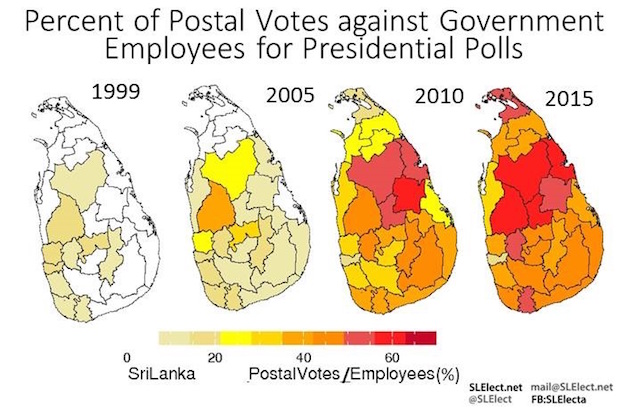 *Maps: For each Presidential Election from 1999 to 2015, the total postal votes in a district is shown as a percentage of the number of government employees in that district.
To check whether the rise in particular districts is driven by increases in numbers of government employees, we can check the ratio of the postal votes to the number of government employees. The second panel of maps (below) shows that Kurunegala had the highest ratio of postal votes / government employees in 1999. However, in 2010, Polonnaruwa had the highest ratio followed by Trincomalee, Anurhadhapura and Matale. In 2015, intriguingly, the ratio for Polonannaruwa dropped and Trincomalee, Anurhadhapura, Matale, and Kurunegala had the highest tier of ratios.
Some of this rise in could be due to an expansion in the armed forces. These personnel are likely to register for postal voting at higher rates (up to 60-70%) compared with other government employees.
At a national level, the rise in armed forces by 200-250,000 can explain only part of the rise in postal voters; it cannot explain the rise in postal voting after 2009, as the armed personnel numbers stabilized or declined slightly.
Voting Patterns by District during the 2015 Presidential Polls
If one looks at the gains in postal voting percentages for either major candidate, there is a split between the votes for the incumbent and the opposition (see companion article at www.slelect.net ). While there is suspicious patterns in the postal voting one can rule out across the board fraud.
Districts That Puzzle
Colombo is home to the largest number of government employees from 1982 to 2015. Yet, by 2015 there are eight districts that have more postal votes than it. Some observations regards Kurunegala, Trincomalee, Jaffna, Gampaha, Colombo are provided below. The districts of Anurhadhapura, Kandy, Matale, and Matara are also suspect.
Kurunegala: Has had both the highest number of postal voters and the highest number of ghost voters since 1999 – a year which has been widely reported to have had outrageous voter fraud which was not punished. If indeed fraud through postal voter did it take place, it could explain up to 40% of the ghost voters.
Trincomalee: has the highest ratio of postal votes to government employees. Is it correct to surmise that the recruitment to the armed forces from this district shall be limited given its demographics? If so what accounts for its large number of postal voters? Of relevance is the discovery of 15,000 fraudulent ballot papers in Kantalai 10 days prior to the 2015 parliamentary elections and the arrest of a deputy minister for walking in unauthorized into a postal voting booth in Trincomalee.
Jaffna: Why did postal voting in Jaffna rise up dramatically in 2015? Is this simply the removal of bottlenecks to voting – if so how does one explain the 60% ration of postal votes/government employees ?
- Can we surmise there is little hiring to the armored forces from Jaffna residents?
- Are there estimates of persons who re-settled or have migrated to Jaffna?
- Could this be explained by relocation of residence of officials from the Wanni to Jaffna after 2009? Of relevance is that the voter lists from 2008 were used in the 2010 elections.
- Does the open rigging in the Jaffna Islands noted by SRH Hoole (Sri Lanka Guardian, July 23, 2011) and quantified by Indi Samarajiva extend to postal voting?
Gampaha: has low voter registration than the age-eligible population but its share of postal voters has been rising dramatically in relation to Colombo. The rise is quite large after 1999 and has continued in recent years particularly after 2010. This was a district tended by Basil Rajapakse for the 2015 elections.
Colombo: has had the highest number of government employees, but its contribution to the postal votes ranks 9th of 25 districts. This may be partially explained if the recruitment to the armed forces is extremely low in Colombo.
Polonnaruwa: The district that had the highest ratio of postal votes to government employees in 2010 dropped to the second tier in 2015. Could it be that the voter fraud operation in the district in 2015 was compromised as one leader went over to the opposition ?
The rise in postal voting in Kalutara, Ratnapura, Moneragala, Nuwara Eliya and Hambantota districts while significant was relatively smaller than the rise in ghost voters.
What have we learned?
In attempting to unravel the 4.5 fold rise in postal voting, we have been constrained by
- the lack of postal voting data at electorate or polling division level
- the lack of district based estimates for armed forces domicile
- lack of information on practices and policies
- Insights from different government establishments.
Still the analysis shows that
- Postal voting shows excessive rise in districts with higher ghost voters – but not all districts that have highest ghost voters are in the high tier of postal voting.
- The rise in postal voting can only account for a modest fraction of ghost voting. At most, there could be only be 2lakhs of votes cast on behalf of ghosts – that was estimated to range from 10-20 lakhs
- The unusually large postal voting shows a spatial pattern in its evolution. It starts in Kurunegala in 1999 and spreads to neighbouring districts in a creeping pattern from election to election. There is a second locus of more modest rising postal votes in the South.
- The rise in ghost voters corresponds with the rapid increase in postal voters in Kurunegala, Anurhadapura, Matale, Polonnaruwa.
- The exceptions to this are in Trincomalee, Jaffna and Gampaha. These districts may be also having high voter fraud.
This analysis bears refinement and we hope you can contribute to this effort.
*This work has been carried out by a volunteer effort by a collective of Sri Lankans (Sri Lankan Election Analytics) to contribute to fair elections and informed citizen. You can contribute at www.slelect.net, reach us at slelect@mail.com and be updated via facebook and @select.
S.Modaya / August 9, 2015
Good work! Thanks to team..
Ghost voters are paid by corrupt politicians to chose them as “people’s representatives” in a democracy morphed into a circus in the Miracle of Modays..
Rajapaksa has lots of ghosts voting for him, which is why people in Hambantota are seeing ghosts walking around…
/
Amarasiri / August 9, 2015
ZL Mohamed
“The numbers of postal votes increased 5-fold between the Presidential Elections in 1982 and 2015 while the population only increased by a third. While postal votes rose by 50% in the sixteen years prior to 1999, it increased by 300% in the next sixteen years. Less than 20% of the government employees used the postal voter facility before 1999. Since then this ratio has doubled and in four districts exceeds 60%.”
What is the best way detect individual postal notes?
/
ZLM / August 10, 2015
@Amarasiri
I am not sure I understand the question. In general, this sort of statistical analysis can only pull out patterns, as you know.
Incidentally, the twitter handle at the end of the article had a typo – its @slelect
/
Amarasiri / August 10, 2015
ZLM
“What is the best way detect individual postal notes?”
Currency notes, bank checks, etc have water marks ans serial numbers that identify the note and check. When a postal vote ballot is issued to a particular voter, is that number identified with the Identification Number or Identity card of the Voter, and then transmitted to the polling district, to be crossed out because of postal voter ballot being issued?
What prevents a voter to get a postal voting ballot and in addition voting on election day at the polling booth?
Wondering where the checks and balances are knowing there there will be fraud. What is the punishment for being caught?
We know even killers and murderers are not being punished. That is a different story.
/
Dinuk / August 9, 2015
Yes, good research here…After the election is won by good governance groups must keep up good work and strive to bring a new political culture by cleaning up POLITICAL PARTIES and holding them ACCOUNTABLE..
There needs to be Chapter on political parties in the Sri Lanka Constitution and national principals for all political parties which need to be democratized and to stop the nasty, corrupt and brutal political culture in the country.
The culture of politicians crossing over for financial gain and perks form one party to another must stop.
There should be a chapter in a New Constitution of Sri Lanka on good governance for political parties. This is the new trend in global good governance and democratization since it is increasingly recognized that political parties determine the course of democracy in a country but there is little about them in the Constitution of a country. This must change.
Cleaning out Political Parties and bringing in a new Sri Lanka National constitution that has a CHAPTER ON PRINCIPLES AND PRACTICE essential for GOOD GOVERNANCE in POLITICAL PARTIES and the principles of GOOD GOVERNANCE IN POLITICAL PARTIES. Political parties are the root of the problem of corrupt democracy. UNP is a dictatorship with Ranil who has lost countless elections and SLFP is a party of corrupt thugs. Increasingly in the world it is recognized that political parties need good governance principle laid out in constitution of the country. Politicians crossing floor of the house for the highest bidder and becoming a power elite and super caste is partly because of lack of democracy in political parties.
/
Vetmahadeva / August 9, 2015
I opine that ghost voters in postal voting shouldn’t be a case or rather cannot be occurring, if there is strict discipline prevails by chain of command within a peripheral unit and certainly in between collection of peripheral units and the central unit that supervises those units of a Government Office that seeks postal voting; I mean to say that if entire Administrative chain of command set up of an Office of the Government is Steady and Vigilant during processing of Postal voting Applications -in that case how the number of voters can increase without the knowledge the respective head of the unit? for that matter without entire would know what is taking place – Is this reflection of Public Service is in complete derailment or in total disarray! Okkama Howla nam Okkama oula thamai
Coming back to the point in reference my opinion emanate from my experience gathered before the 13th amendment is introduced, but our Department of Animal Health and Production set up did not have a much of a drastic difference before and after 13th amendment; 10 to 15 peripheral units at least 10 to 12 capacity were supervised by an Area AD, who will obtain the name list of all who wanted to vote through postal system and in turn will recommend the Application proper Thru Directorate Office, similarly 5 to 8 AD office name list would be sought by Directorate Office and it would be processed duly.
Now where the loophole that give births to abundance of Ghost Votes in almost all the districts these days? Is it a drain rendered by the 13th Amendment or
brooded cleverly by corrupt politicians -Okkama Howla nam Okkama oula thamai
/
ZLM / August 10, 2015
Thank you for your account of Postal Voting in the Department of Animal Health and Production. It gives us insight on how voting took place within a department which was spread out. As you note, there was little expansion in postal voting as well before and after the 13A (1987) as you can see from the maps above or more clearly from the supplementary .
As you note, postal voting can be made fool-proof if the administrative service was led by conscientious officers, public administration did not get cowed entirely by politicians and opposing trade unions would have acted as a check.
Perhaps between the period of the 13th Amendment (1987) and the 18th A (2010) (which stripped the public administration of protection) these checks on ensuring fool proof postal voting was compromised in some Departments.
/
justice / August 9, 2015
This is why it is high time that Electronic Voting which is the norm in western democracies, should be adopted.
This prevents anyone from voting twice at any election.
This was proposed a few years ago, but was almost unanimously rejected.
The reason was probably that ALL parties desired loopholes in the casting of ballots,as, non-registration of voters, impersonation, ballot box stuffing, bogus vote printing, deceitful counting at counting centres etc., were desired/accepted.
There was even a politician who boasted “I know how to win any election”!!
/
f=ma / August 9, 2015
According to the UNP, the ghost voters are ex-white van detainees who were previously unaccounted for and are now liberated.
/
f=ma / August 9, 2015
According to the UNP, the ghost voters are ex-white van detainees who were previously unaccounted for and are now liberated lol
/
Analyst / August 9, 2015
QUESTION to the Election Commissioner,,,,, why MR cut outs are all over Pannipitiya in preparation for MRs Meeting??
Has not the Commississioner seen or been informed?
Why the thuggery by these village modayas been allowed in Pannipitiya village .Are they so thick or they all village thugs??
The Commissioner should act immediately they are making a mockery of the Election Rules and disobeying the Commissioner ‘s order.
What an unruly country. Just the Banana Republic nothing else.
‘
/
Ella Kollage Appachchi / August 14, 2015
Lareef
Did you take into account the huge expansion of the armed forces during MR regime?
/